Skip to main content
GOB Chemistry
My Course
Learn
Exam Prep
AI Tutor
Study Guides
Textbook Solutions
Flashcards
Explore
Try the app
My Course
Learn
Exam Prep
AI Tutor
Study Guides
Textbook Solutions
Flashcards
Explore
Try the app
Back
Properties of Alcohols definitions
You can tap to flip the card.
Alcohols
You can tap to flip the card.
👆
Alcohols
Organic compounds containing a hydroxyl group, notable for higher boiling points and water solubility compared to similar hydrocarbons.
Track progress
Control buttons has been changed to "navigation" mode.
1/14
Related flashcards
Related practice
Recommended videos
Properties of Alcohols quiz
Properties of Alcohols
15 Terms
Naming Ethers
14. Compounds with Oxygen or Sulfur
5 problems
Topic
Jules
14. Compounds with Oxygen or Sulfur
7 topics
15 problems
Chapter
Jules
Guided course
0:56
Solubility Concept 2
4
views
Guided course
1:23
Boiling Point Concept 1
3
views
Guided course
1:21
Boiling Point Example 1
5
views
Terms in this set (14)
Hide definitions
Alcohols
Organic compounds containing a hydroxyl group, notable for higher boiling points and water solubility compared to similar hydrocarbons.
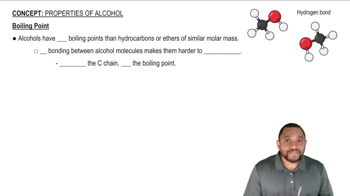
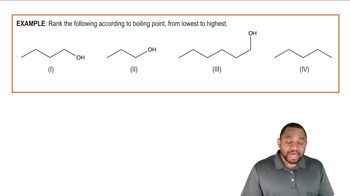
Boiling Point
Temperature at which a substance transitions from liquid to gas; elevated in alcohols due to strong intermolecular forces.
Hydrogen Bonding
Attractive force between partially positive hydrogen and partially negative oxygen, significantly raising boiling point in alcohols.
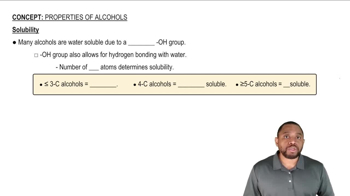
Hydroxyl Group
Polar functional group consisting of an oxygen and hydrogen atom, responsible for alcohols' solubility and hydrogen bonding.
Intermolecular Forces
Forces acting between molecules, including hydrogen bonding and London dispersion, influencing physical properties like boiling point.
Polarity
Uneven distribution of charge within a molecule, enhanced by hydroxyl groups, increasing solubility in water.
Solubility
Ability of a substance to dissolve in a solvent; in alcohols, determined by hydroxyl group and carbon chain length.
Carbon Chain
Sequence of carbon atoms in a molecule; longer chains increase boiling point and decrease solubility in alcohols.
Diols
Compounds with two hydroxyl groups, exhibiting higher boiling points and greater solubility than monohydric alcohols.
Triols
Compounds with three hydroxyl groups, showing even higher boiling points and solubility compared to diols and monohydric alcohols.
Monohydric Alcohols
Alcohols containing a single hydroxyl group, with lower boiling points and solubility than diols or triols.
London Dispersion Forces
Weak intermolecular forces arising from temporary dipoles, increasing with molecular size and affecting boiling point.
Functional Groups
Specific groups of atoms within molecules, such as hydroxyl, determining chemical and physical properties.
Molar Mass
Mass of one mole of a substance; comparison with alcohols highlights their elevated boiling points due to hydrogen bonding.
 BackBack
 0:56
0:56