GOB Chemistry
My Course
Learn
Exam Prep
AI Tutor
Study Guides
Textbook Solutions
Flashcards
Explore
Try the app
My Course
Learn
Exam Prep
AI Tutor
Study Guides
Textbook Solutions
Flashcards
Explore
Try the app
Back
pH of Strong Acids and Bases quiz
You can tap to flip the card.
What does it mean for a strong acid or base to completely ionize in water?
You can tap to flip the card.
👆
What does it mean for a strong acid or base to completely ionize in water?
It means that 100% of the acid or base molecules break up into their ions in solution.
Track progress
Control buttons has been changed to "navigation" mode.
1/15
Related flashcards
Related practice
Recommended videos
pH of Strong Acids and Bases definitions
pH of Strong Acids and Bases
13 Terms
pH of Strong Acids and Bases
10. Acids and Bases
6 problems
Topic

Jules
Acid-Base Equivalents
10. Acids and Bases
3 problems
Topic
Jules
10. Acids and Bases - Part 1 of 2
6 topics
13 problems
Chapter
Jules
10. Acids and Bases - Part 2 of 2
8 topics
13 problems
Chapter
Jules
Guided course
02:39
Strong Acids and Bases
8
views
Guided course
01:18
pH of Strong Acids and Bases Example
6
views
Terms in this set (15)
Hide definitions
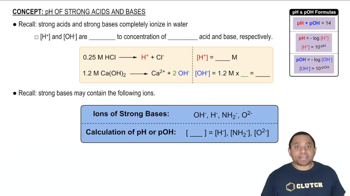
What does it mean for a strong acid or base to completely ionize in water?
It means that 100% of the acid or base molecules break up into their ions in solution.
How does the concentration of H+ ions compare to the concentration of a strong acid like HCl?
The concentration of H+ ions is equal to the concentration of the strong acid because it completely ionizes.
If you have 0.25 M HCl, what is the concentration of H+ ions in solution?
The concentration of H+ ions is 0.25 M, the same as the initial HCl concentration.
How do you determine the concentration of OH- ions for a strong base like Ca(OH)2?
Multiply the base's molarity by the number of OH- ions produced per formula unit; for Ca(OH)2, it's 1.2 M × 2 = 2.4 M.
What are the four basic anions found in strong bases?
The four basic anions are hydroxide (OH-), hydride (H-), amide (NH2-), and oxide (O2-).
How do you calculate pH from the concentration of H+ ions?
pH is calculated as the negative logarithm of the H+ ion concentration: pH = -log[H+].
What is the relationship between pH and pOH in aqueous solutions?
pH plus pOH always equals 14 in aqueous solutions.
How do you find the H+ concentration if you know the pH?
H+ concentration is 10 raised to the negative pH: [H+] = 10^(-pH).
How do you calculate pOH from the concentration of OH- ions?
pOH is calculated as the negative logarithm of the OH- ion concentration: pOH = -log[OH-].
If you know the pOH, how do you find the OH- concentration?
OH- concentration is 10 raised to the negative pOH: [OH-] = 10^(-pOH).
Why is an ICE chart not needed for strong acids and bases when calculating pH or pOH?
Because strong acids and bases completely ionize, their ion concentrations are equal to their initial concentrations.
What does a single arrow in a chemical equation for a strong acid or base indicate?
It indicates that the reaction goes to completion with 100% ionization.
What is the pH of a 1.0 × 10^-3 M HCl solution?
The pH is 3, since pH = -log(1.0 × 10^-3) = 3.
How does the number of OH- ions produced affect the calculation of OH- concentration for strong bases?
You must multiply the base's molarity by the number of OH- ions produced per formula unit.
What is the definition of a strong electrolyte in the context of acids and bases?
A strong electrolyte is a substance that completely dissociates into ions in solution.