Back

pH of Strong Acids and Bases definitions

Control buttons has been changed to "navigation" mode.
1/13
  • Strong Acid

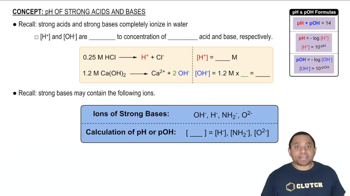
    A substance that completely ionizes in water, producing a concentration of H+ ions equal to its original molarity.
  • Strong Base

    A compound that fully dissociates in water, yielding a concentration of OH- ions matching its initial molarity or adjusted for multiple ions.
  • Electrolyte

    A substance that conducts electricity in solution due to complete ionization into charged particles.
  • Ionization

    The process by which a compound separates into ions when dissolved in water, resulting in charged species.
  • Hydrochloric Acid

    A strong binary acid that dissociates entirely in water, providing an equal concentration of H+ ions.
  • Hydroxide Ion

    A negatively charged particle produced by strong bases, directly influencing pOH calculations.
  • Hydride Ion

    A basic anion present in some strong bases, treated equivalently to OH- in concentration calculations.
  • Amide Ion

    A basic anion found in certain strong bases, considered equal to OH- for determining solution basicity.
  • Oxide Ion

    A basic anion from strong bases, factored into OH- concentration for pOH and pH calculations.
  • Molarity

    A measure of concentration indicating moles of solute per liter of solution, crucial for ion calculations.
  • pH

    A logarithmic scale value representing the negative log of H+ ion concentration in a solution.
  • pOH

    A logarithmic measure calculated as the negative log of OH- ion concentration in a solution.
  • Dissociation

    The separation of a compound into its constituent ions in solution, often complete for strong acids and bases.