GOB Chemistry
My Course
Learn
Exam Prep
AI Tutor
Study Guides
Textbook Solutions
Flashcards
Explore
Try the app
My Course
Learn
Exam Prep
AI Tutor
Study Guides
Textbook Solutions
Flashcards
Explore
Try the app
Back
Parts per Million (ppm) quiz
You can tap to flip the card.
What does PPM stand for and what does it measure?
You can tap to flip the card.
👆
What does PPM stand for and what does it measure?
PPM stands for parts per million and it measures extremely dilute solution concentrations in either mass or volume.
Track progress
Control buttons has been changed to "navigation" mode.
1/15
Related flashcards
Related practice
Recommended videos
Parts per Million (ppm) definitions
Parts per Million (ppm)
12 Terms
Parts per Million (ppm)
9. Solutions
1 problem
Topic

Jules
Solubility: Temperature Effect
9. Solutions
4 problems
Topic
Jules
9. Solutions - Part 1 of 3
5 topics
12 problems
Chapter
Jules
9. Solutions - Part 2 of 3
7 topics
11 problems
Chapter
Jules
9. Solutions - Part 3 of 3
7 topics
11 problems
Chapter
Jules
Guided course
01:24
Parts per Million (ppm) Example 2
2
views
Guided course
01:38
Parts per Million (ppm) Concept 1
2
views
Guided course
01:12
Parts per Million (ppm) Example 1
2
views
Terms in this set (15)
Hide definitions
What does PPM stand for and what does it measure?
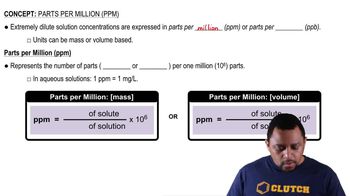
PPM stands for parts per million and it measures extremely dilute solution concentrations in either mass or volume.
How is 1 PPM expressed in aqueous solutions?
1 PPM is equivalent to 1 milligram of solute per 1 liter of solution in aqueous solutions.
What is the formula for calculating PPM in terms of mass?
PPM (mass) = (grams of solute / grams of solution) × 10^6.
What is the formula for calculating PPM in terms of volume?
PPM (volume) = (milliliters of solute / milliliters of solution) × 10^6.
How many parts does PPM refer to?
PPM refers to 1 part per 1,000,000 parts, or 10^6 parts.
What does PPB stand for and what does it measure?
PPB stands for parts per billion and it measures even more dilute solution concentrations than PPM.
How is 1 PPB expressed in aqueous solutions?
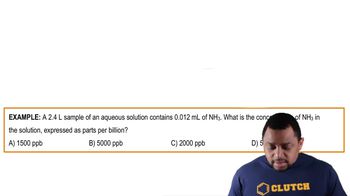
1 PPB is equivalent to 1 microgram of solute per 1 liter of solution in aqueous solutions.
What is the formula for calculating PPB in terms of mass?
PPB (mass) = (grams of solute / grams of solution) × 10^9.
What is the formula for calculating PPB in terms of volume?
PPB (volume) = (milliliters of solute / milliliters of solution) × 10^9.
How many parts does PPB refer to?
PPB refers to 1 part per 1,000,000,000 parts, or 10^9 parts.
Why do we use PPM and PPB instead of percent for very dilute solutions?
We use PPM and PPB because percent is not precise enough for extremely low concentrations.
How is the calculation for PPM similar to mass percent?
Both use the ratio of solute to solution, but PPM multiplies by 10^6 instead of 100.
What units can be used for PPM and PPB calculations?
Both mass (grams) and volume (milliliters) can be used for PPM and PPB calculations.
Which is a finer measure of concentration, PPM or PPB?
PPB is a finer measure of concentration than PPM.
What is the relationship between 1 PPM and 1 PPB in terms of concentration?
1 PPM is 1,000 times greater than 1 PPB.