Back

Oxidative Phosphorylation quiz

Control buttons has been changed to "navigation" mode.
1/15
  • What is oxidative phosphorylation?

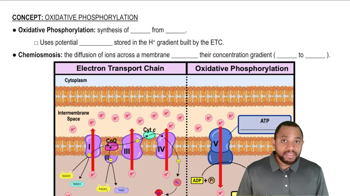
    Oxidative phosphorylation is the synthesis of ATP from ADP using energy from a proton gradient created by the electron transport chain.
  • What creates the proton gradient used in oxidative phosphorylation?

    The electron transport chain creates the proton gradient by pumping protons into the intermembrane space at complexes 1, 3, and 4.
  • What is chemiosmosis in the context of oxidative phosphorylation?

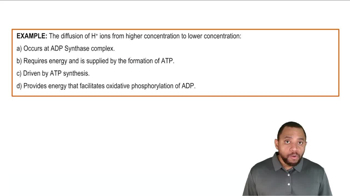
    Chemiosmosis is the diffusion of ions, specifically protons, across a membrane down their concentration gradient.
  • Which complexes in the electron transport chain pump protons into the intermembrane space?

    Complexes 1, 3, and 4 pump protons into the intermembrane space.
  • Where does NADH donate its electrons in the electron transport chain?

    NADH donates its electrons at complex 1 of the electron transport chain.
  • Where does FADH2 donate its electrons in the electron transport chain?

    FADH2 donates its electrons at complex 2 of the electron transport chain.
  • What role does coenzyme Q play in the electron transport chain?

    Coenzyme Q shuttles electrons from complexes 1 and 2 to complex 3.
  • What is the function of cytochrome c in the electron transport chain?

    Cytochrome c shuttles electrons from complex 3 to complex 4.
  • What acts as the final electron acceptor in oxidative phosphorylation?

    Oxygen acts as the final electron acceptor at complex 4, resulting in the formation of water.
  • What is the function of ATP Synthase (complex 5) in oxidative phosphorylation?

    ATP Synthase uses the proton gradient to convert ADP into ATP by adding an inorganic phosphate.
  • How does proton movement through ATP Synthase drive ATP production?

    The movement of protons back into the matrix through ATP Synthase releases energy that drives the phosphorylation of ADP to ATP.
  • How many ATP molecules are theoretically produced from oxidative phosphorylation per two cycles of the TCA cycle?

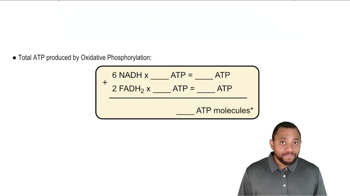
    Theoretically, 18 ATP molecules are produced per two cycles of the TCA cycle (15 from NADH and 3 from FADH2).
  • How many ATP molecules are produced per NADH and per FADH2 in oxidative phosphorylation?

    Each NADH produces 2.5 ATP, and each FADH2 produces 1.5 ATP.
  • Why might the actual ATP yield from oxidative phosphorylation differ from the theoretical yield?

    The actual ATP yield can vary due to different cellular conditions affecting the efficiency of the process.
  • What is the main payoff of the electron transport chain in cellular respiration?

    The main payoff is the generation of ATP at complex 5 (ATP Synthase) using the proton gradient created by the electron transport chain.