Back

Oxidation of Monosaccharides quiz

Control buttons has been changed to "navigation" mode.
1/15
  • What is formed when an aldose monosaccharide undergoes oxidation?

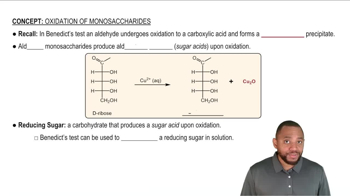
    An aldonic acid is formed when an aldose monosaccharide undergoes oxidation.
  • What is the visible result of a positive Benedict's test for reducing sugars?

    A brick red precipitate of copper(I) oxide is formed.
  • How does the suffix of a sugar's name change when it is oxidized in Benedict's test?

    The suffix changes from 'ose' to 'onic acid' to indicate the formation of an aldonic acid.
  • What is a reducing sugar?

    A reducing sugar is a carbohydrate that produces a sugar acid upon oxidation.
  • Which ion is used to oxidize aldose sugars in Benedict's test?

    Copper(II) ion is used to oxidize aldose sugars.
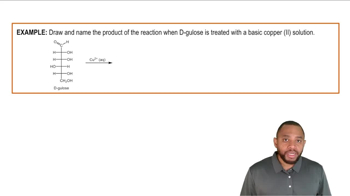
  • What is the product when D-ribose is oxidized in Benedict's test?

    D-ribose is oxidized to ribonic acid.
  • What is the byproduct formed during the oxidation of aldose sugars in Benedict's test?

    Copper(I) oxide, which appears as a brick red precipitate, is the byproduct.
  • Can ketose sugars act as reducing sugars? Why or why not?

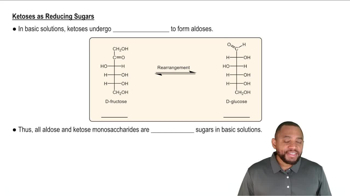
    Yes, ketose sugars can act as reducing sugars because they can rearrange to form aldose sugars in basic solutions.
  • What structural change occurs to ketose sugars in basic solutions?

    Ketose sugars undergo rearrangement from a ketone group to an aldehyde group.
  • What does Benedict's test detect in a solution?

    Benedict's test detects the presence of reducing sugars.
  • What happens to the number of carbons when a ketose sugar rearranges to an aldose sugar?

    The number of carbons remains the same during the rearrangement.
  • What is the significance of the brick red precipitate in Benedict's test?

    It indicates the presence of reducing sugars that have been oxidized.
  • Are all monosaccharides reducing sugars in basic solutions?

    Yes, both aldose and ketose monosaccharides are reducing sugars in basic solutions.
  • What is the chemical group formed at the end of an aldose sugar after oxidation?

    A carboxylic acid group is formed at the end of the sugar.
  • Why are reducing sugars not limited to aldose sugars?

    Because ketose sugars can rearrange to form aldose sugars in basic solutions, making them reducing sugars as well.