Back

Oxidation of Monosaccharides definitions

Control buttons has been changed to "navigation" mode.
1/13
  • Aldose

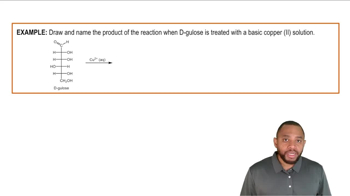
    A monosaccharide containing an aldehyde group, commonly undergoing oxidation to form sugar acids.
  • Monosaccharide

    A simple carbohydrate molecule, serving as the basic unit for sugars like D-ribose and D-fructose.
  • Aldonic Acid

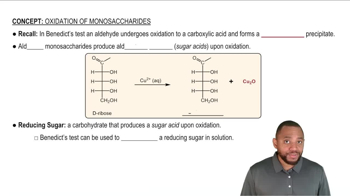
    A sugar acid formed when an aldose is oxidized, indicated by the suffix change from 'ose' to 'onic acid'.
  • Copper(II) Ion

    An oxidizing agent in Benedict's test, responsible for converting aldose sugars into carboxylic acids.
  • Copper(I) Oxide

    A brick red precipitate produced as a byproduct during the oxidation of reducing sugars in Benedict's test.
  • Benedict's Test

    A chemical assay used to detect reducing sugars by observing the formation of a colored precipitate.
  • Reducing Sugar

    A carbohydrate capable of being oxidized to a sugar acid, detectable by Benedict's test.
  • Carboxylic Acid Group

    A functional group formed on a sugar after oxidation, replacing the original aldehyde group.
  • Ketose

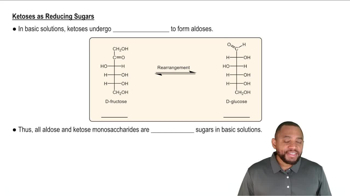
    A monosaccharide containing a ketone group, capable of rearranging to form an aldose in basic solutions.
  • Ketone Group

    A functional group present in certain sugars, which can convert to an aldehyde group under basic conditions.
  • Aldehyde Group

    A functional group in aldose sugars, targeted during oxidation to form carboxylic acids.
  • Sugar Acid

    A product of monosaccharide oxidation, characterized by the presence of a carboxylic acid group.
  • Basic Solution

    A chemical environment that enables ketose sugars to rearrange into aldose forms, expanding the range of reducing sugars.