Back

Law of Definite Proportions quiz

Control buttons has been changed to "navigation" mode.
1/15
  • Who originated the law of definite proportions and in what year?

    Joseph L. Proust originated the law of definite proportions in 1799.
  • What is another name for the law of definite proportions?

    It is also known as Proust's law or the law of constant composition.
  • What does the law of definite proportions state about pure chemical compounds?

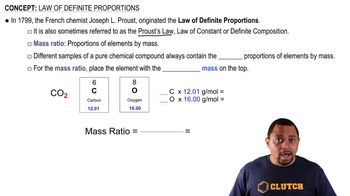
    It states that any pure chemical compound always contains the same proportions of elements by mass, regardless of the sample's source.
  • What is a mass ratio in the context of the law of definite proportions?

    A mass ratio is a fraction or proportion of elements by mass in a compound.
  • How do you determine the mass ratio for a compound?

    Place the element with the larger mass on top and the smaller mass on the bottom in the ratio.
  • What is the atomic mass of carbon used in the CO2 example?

    The atomic mass of carbon is 12.01 grams per mole.
  • What is the atomic mass of oxygen used in the CO2 example?

    The atomic mass of oxygen is 16 grams per mole.
  • How much total mass does oxygen contribute in one mole of CO2?

    Oxygen contributes 32 grams total in one mole of CO2.
  • How much total mass does carbon contribute in one mole of CO2?

    Carbon contributes 12.01 grams total in one mole of CO2.
  • What is the mass ratio of oxygen to carbon in CO2?

    The mass ratio is approximately 2.66, meaning 2.66 grams of oxygen for every gram of carbon.
  • If you compare CO2 samples from two different cities, what should you find according to the law of definite proportions?

    Both samples should have the same mass ratio if they are indeed CO2.
  • Why is the mass ratio important in identifying compounds?

    The mass ratio helps determine if two samples are the same compound by comparing their proportions of elements by mass.
  • What does the law of definite proportions hinge on?

    It hinges on the consistency of mass ratios across different samples of the same compound.
  • How can the law of definite proportions be used with unknown samples?

    By comparing the mass ratio of a known sample to an unknown sample, you can determine if they are the same compound.
  • What is the significance of multiplying the number of each element by its atomic mass in a compound?

    It shows how much each element contributes to the overall mass of the compound.