 Back
BackLaw of Definite Proportions definitions

 02:00
02:00
Terms in this set (13)
Law of Definite Proportions
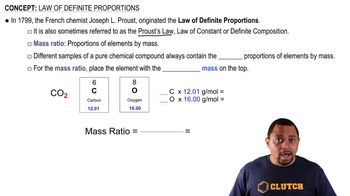
A principle stating that a pure compound always contains the same elements in the same mass ratio, regardless of sample origin.
Proust's Law
An alternative name for the rule that a compound's elemental composition by mass remains constant in all samples.
Law of Constant Composition
A synonym for the concept that a chemical compound's elements are always present in fixed mass proportions.
Mass Ratio
A numerical comparison of the masses of elements in a compound, typically with the larger mass as the numerator.
Chemical Compound
A pure substance formed from two or more elements combined in a fixed mass proportion.
Element
A basic substance that cannot be broken down further and combines in set ratios to form compounds.
Atomic Mass
A value representing the mass of an atom, usually measured in grams per mole, used to calculate mass ratios.
Sample
A portion of a substance taken for analysis to determine its composition or verify its identity.
CO2
A compound consisting of one carbon atom and two oxygen atoms, used as an example to illustrate fixed mass ratios.
Periodic Table
A chart organizing elements by atomic number, providing atomic masses essential for calculating mass ratios.
Proportion
A comparative relationship between quantities, such as the fixed mass relationship of elements in a compound.
Grams per Mole
A unit expressing atomic or molecular mass, crucial for determining the mass contributions of elements in compounds.
Joseph L. Proust
The French chemist credited with formulating the principle that compounds have constant elemental mass ratios.