Back

Law of Conservation of Mass quiz

Control buttons has been changed to "navigation" mode.
1/15
  • Who is credited with originating the law of conservation of mass?

    Antoine Levasseur, a French chemist, is credited with originating the law in 1789.
  • What does the law of conservation of mass state about matter in a chemical reaction?

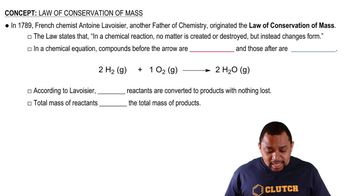
    It states that matter is neither created nor destroyed, but only changes form during a chemical reaction.
  • In a chemical reaction, what are the substances present before the reaction called?

    They are called reactants.
  • What are the substances formed as a result of a chemical reaction called?

    They are called products.
  • If you start with 100 grams of reactants, how much product should you have after the reaction according to the law of conservation of mass?

    You should have 100 grams of product, as mass is conserved.
  • How does the law of conservation of mass relate to the total mass of reactants and products?

    The total mass of reactants equals the total mass of products in a chemical reaction.
  • What example is given to illustrate the law of conservation of mass?

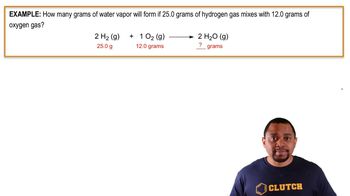
    The reaction of hydrogen (H2) and oxygen (O2) to form water (H2O) is used as an example.
  • Why is nothing truly lost in a chemical reaction according to the law of conservation of mass?

    Because all reactants are converted to products, just in a different form.
  • How does the law of conservation of mass help in chemistry calculations?

    It helps determine the amount of product that can be formed from a given amount of reactants.
  • What year did Antoine Levasseur originate the law of conservation of mass?

    He originated the law in 1789.
  • How does the law of conservation of mass connect to stoichiometry?

    It provides the basis for calculating the amounts of reactants and products in chemical reactions.
  • What does the arrow in a chemical equation separate?

    It separates the reactants (before the arrow) from the products (after the arrow).
  • What fundamental principle does the law of conservation of mass demonstrate in chemical reactions?

    It demonstrates that the total mass remains constant throughout the reaction.
  • How does the law of conservation of mass relate to solution chemistry?

    It ensures that the mass of substances in solution is conserved during chemical changes.
  • What must be true about the mass of reactants and products for the law of conservation of mass to hold?

    The mass of the reactants must equal the mass of the products.