Back

Introduction to Organic Chemistry quiz

Control buttons has been changed to "navigation" mode.
1/15
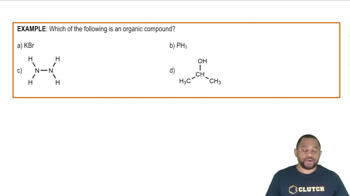
  • What is the main focus of organic chemistry?

    Organic chemistry studies the structure, properties, and reactions of carbon-containing compounds.
  • What are hydrocarbons composed of?

    Hydrocarbons are organic compounds made up only of carbon and hydrogen atoms.
  • Which elements, besides carbon and hydrogen, are commonly found in organic compounds?

    Organic compounds can also contain oxygen, nitrogen, sulfur, and halogens.
  • What is a key feature of organic compounds regarding their bonding?

    A key feature is carbon atoms single bonded to other carbons and to hydrogens.
  • What is propane and where is it commonly used?

    Propane is a hydrocarbon found in propane tanks used for barbecues and other everyday uses.
  • What distinguishes ethanol from propane as an organic compound?

    Ethanol contains an oxygen atom in the form of an OH group, unlike propane which has only carbon and hydrogen.
  • What elements are present in caffeine besides carbon and hydrogen?

    Caffeine contains nitrogen atoms and double bonds in addition to carbon and hydrogen.
  • Where is geraniol commonly found and what structural features does it have?

    Geraniol is found in roses and contains pi bonds, double bonds, and an OH group.
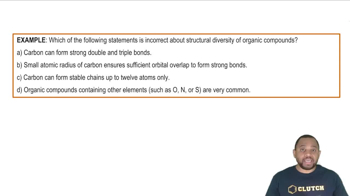
  • Why do organic compounds exhibit structural diversity?

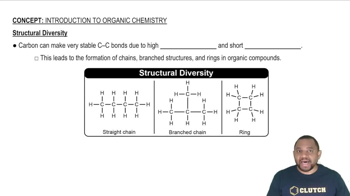
    Structural diversity arises because carbon forms stable, high-energy bonds with short bond lengths.
  • What types of structures can carbon form in organic compounds?

    Carbon can form chains, branched structures, and rings in organic compounds.
  • What is a straight-chain hydrocarbon?

    A straight-chain hydrocarbon consists of carbon atoms connected in a linear sequence with hydrogens attached.
  • What is a branched hydrocarbon?

    A branched hydrocarbon has a main chain of carbons with one or more carbon groups branching off.
  • What is a cyclic hydrocarbon?

    A cyclic hydrocarbon has carbon atoms arranged in a ring or cycle, such as a square of four carbons.
  • What allows carbon to form diverse organic molecules?

    Carbon's ability to make stable bonds with high bond energy and short bond length enables diverse structures.
  • What is the significance of carbon-hydrogen bonds in organic chemistry?

    Carbon-hydrogen bonds are fundamental to organic compounds and their reactions.