Back

Intro to Citric Acid Cycle quiz

Control buttons has been changed to "navigation" mode.
1/15
  • What are the other names for the Citric Acid Cycle?

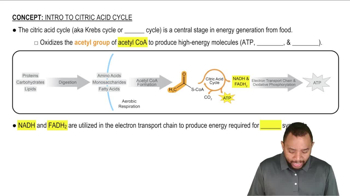
    The Citric Acid Cycle is also known as the Krebs Cycle and the TCA Cycle.
  • What is the main function of the Citric Acid Cycle?

    Its main function is to oxidize the Acetyl group of Acetyl CoA to produce ATP, NADH, and FADH2.
  • What are the four stages of food catabolism?

    The four stages are digestion, breakdown into basic units, formation of Acetyl CoA, and entry into the Citric Acid Cycle.
  • What molecules are produced during the Citric Acid Cycle?

    ATP, NADH, and FADH2 are produced during the Citric Acid Cycle.
  • What happens to NADH and FADH2 after the Citric Acid Cycle?

    They are utilized in the Electron Transport Chain (ETC) to produce additional ATP.
  • What is the first phase of the Citric Acid Cycle?

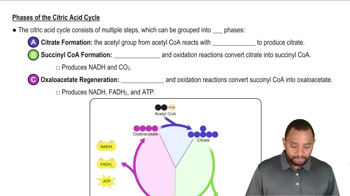
    The first phase is citrate formation, where Acetyl CoA reacts with Oxaloacetate to form citrate.
  • What is the second phase of the Citric Acid Cycle called?

    The second phase is Succinyl CoA formation, involving isomerization and oxidation reactions.
  • What is produced during the conversion of citrate to Succinyl CoA?

    NADH and carbon dioxide are produced during this conversion.
  • What is the third phase of the Citric Acid Cycle?

    The third phase is oxaloacetate regeneration, converting Succinyl CoA back to Oxaloacetate.
  • What energy molecules are generated during oxaloacetate regeneration?

    NADH, FADH2, and some ATP are generated during this phase.
  • What is the starting molecule for the Citric Acid Cycle?

    The starting molecule is Acetyl CoA.
  • What does Acetyl CoA react with to begin the Citric Acid Cycle?

    Acetyl CoA reacts with Oxaloacetate to form citrate.
  • What is the role of the Electron Transport Chain in cellular respiration?

    The ETC uses NADH and FADH2 to produce ATP.
  • What are the basic units formed from digestion of proteins, carbohydrates, and lipids?

    Amino acids, monosaccharides, and fatty acids are formed.
  • Why is the Citric Acid Cycle considered a cyclic metabolic pathway?

    Because it regenerates oxaloacetate at the end, allowing the cycle to repeat.