Back

Intro to Citric Acid Cycle definitions

Control buttons has been changed to "navigation" mode.
1/15
  • Citric Acid Cycle

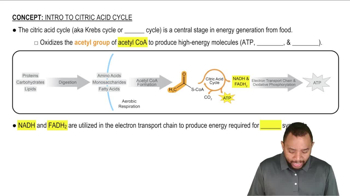
    A cyclic metabolic pathway central to energy production, oxidizing Acetyl groups to generate high-energy molecules for cellular processes.
  • Krebs Cycle

    An alternative name for the Citric Acid Cycle, highlighting its discovery and role in cellular respiration.
  • TCA Cycle

    Another term for the Citric Acid Cycle, emphasizing its involvement with tricarboxylic acids during metabolism.
  • Acetyl CoA

    A key molecule formed from food breakdown, delivering Acetyl groups into the Citric Acid Cycle for oxidation.
  • ATP

    A high-energy molecule produced during the cycle, serving as the main energy currency for cellular activities.
  • NADH

    An electron carrier generated in the cycle, later used in the Electron Transport Chain to drive ATP synthesis.
  • FADH2

    A reduced coenzyme produced in the cycle, contributing electrons to the Electron Transport Chain for energy production.
  • Electron Transport Chain

    A series of protein complexes that use electrons from NADH and FADH2 to generate additional ATP.
  • Citrate

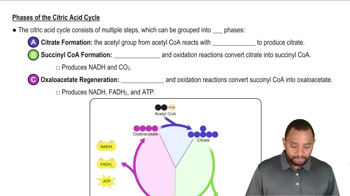
    The first product formed when Acetyl CoA combines with Oxaloacetate, initiating the Citric Acid Cycle.
  • Oxaloacetate

    A four-carbon molecule that reacts with Acetyl CoA to start the cycle and is regenerated at the end.
  • Succinyl CoA

    An intermediate formed during the cycle, produced from citrate through isomerization and oxidation steps.
  • Food Catabolism

    The multi-stage breakdown of proteins, carbohydrates, and lipids into smaller units for energy extraction.
  • Isomerization

    A chemical process within the cycle that rearranges molecules, facilitating subsequent oxidation reactions.
  • Oxidation

    A reaction type in the cycle where electrons are removed from substrates, aiding in energy molecule production.
  • Hydrolysis

    A reaction involving water to break chemical bonds, playing a role in regenerating Oxaloacetate during the cycle.