GOB Chemistry
My Course
Learn
Exam Prep
AI Tutor
Study Guides
Textbook Solutions
Flashcards
Explore
Try the app
My Course
Learn
Exam Prep
AI Tutor
Study Guides
Textbook Solutions
Flashcards
Explore
Try the app
Back
Intro to Amino Acid Catabolism quiz
You can tap to flip the card.
Where are excess amino acids metabolized in the body?
You can tap to flip the card.
👆
Where are excess amino acids metabolized in the body?
Excess amino acids are metabolized in the liver.
Track progress
Control buttons has been changed to "navigation" mode.
1/15
Related flashcards
Related practice
Recommended videos
Intro to Amino Acid Catabolism definitions
Intro to Amino Acid Catabolism
13 Terms
Intro to Amino Acid Catabolism
25. Protein and Amino Acid Metabolism
2 problems
Topic

Nicole
25. Protein and Amino Acid Metabolism
6 topics
12 problems
Chapter
KeyshawnDavis
Guided course
1:14
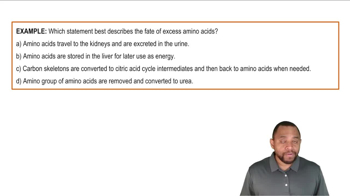
Intro to Amino Acid Catabolism Example 1
Guided course
2:06
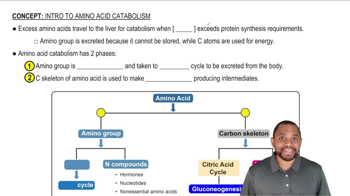
Intro to Amino Acid Catabolism Concept 1
Terms in this set (15)
Hide definitions
Where are excess amino acids metabolized in the body?
Excess amino acids are metabolized in the liver.
Why can't the amino group from amino acids be stored in the body?
The amino group is toxic and cannot be stored in the body.
How is the amino group from amino acids primarily excreted?
It is excreted through the urea cycle as ammonium ion (NH4+).
What are two main phases of amino acid catabolism?
Phase 1 is the removal of the amino group, and Phase 2 is the utilization of the carbon skeleton.
What happens to the carbon skeleton of amino acids after the amino group is removed?
The carbon skeleton is used to generate energy-producing intermediates.
Name two metabolic pathways that use the carbon skeleton from amino acids.
The citric acid cycle and gluconeogenesis use the carbon skeleton.
What is the chemical formula for the ammonium ion produced from amino groups?
The chemical formula is NH4+.
Besides excretion, what else can the amino group from amino acids be used for?
Some amino groups are used to synthesize nitrogen-containing compounds like hormones, nucleotides, and non-essential amino acids.
What is the main purpose of the urea cycle?
The urea cycle removes toxic ammonium ions from the body.
What is gluconeogenesis?
Gluconeogenesis is the creation of sugar from non-carbohydrate sources.
What is ketogenesis?
Ketogenesis is the creation of ketone bodies from the carbon skeleton of amino acids.
Which phase of amino acid catabolism deals with the removal of the amino group?
Phase 1 deals with the removal of the amino group.
Which phase of amino acid catabolism involves the carbon skeleton?
Phase 2 involves the utilization of the carbon skeleton.
What happens to amino acids when their concentration exceeds protein synthesis requirements?
They are catabolized in the liver.
List three types of nitrogen-containing compounds synthesized from amino groups.
Hormones, nucleotides, and non-essential amino acids are synthesized from amino groups.