Skip to main content
GOB Chemistry
My Course
Learn
Exam Prep
AI Tutor
Study Guides
Textbook Solutions
Flashcards
Explore
Try the app
My Course
Learn
Exam Prep
AI Tutor
Study Guides
Textbook Solutions
Flashcards
Explore
Try the app
Back
Hemiacetal and Acetal Formation quiz
You can tap to flip the card.
What functional groups are present on the same carbon in a hemiacetal?
You can tap to flip the card.
👆
What functional groups are present on the same carbon in a hemiacetal?
A hydroxy group (OH) and an alkoxy group (OR) are present on the same carbon in a hemiacetal.
Track progress
Control buttons has been changed to "navigation" mode.
1/15
Related flashcards
Related practice
Recommended videos
Hemiacetal and Acetal Formation definitions
Hemiacetal and Acetal Formation
13 Terms
Hemiacetal and Acetal Formation
15. Aldehydes and Ketones
1 problem
Topic
Laura
Reduction of Aldehydes and Ketones
15. Aldehydes and Ketones
5 problems
Topic
Jules
15. Aldehydes and Ketones
5 topics
13 problems
Chapter
Jules
Guided course
2:17
Formation of Hemiacetals and Acetals Concept 2
2
views
Guided course
1:49
Hemiacetals and Acetals Concept 1
1
views
Guided course
1:08
Formation of Hemiacetals and Acetals Example 2
1
views
Terms in this set (15)
Hide definitions
What functional groups are present on the same carbon in a hemiacetal?
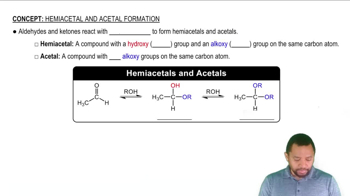
A hydroxy group (OH) and an alkoxy group (OR) are present on the same carbon in a hemiacetal.
What does the 'R' in an alkoxy group (OR) represent?
'R' represents a carbon group, which could be a methyl, ethyl, ring, or a longer carbon chain.
How many moles of alcohol are needed to convert an aldehyde or ketone into a hemiacetal?
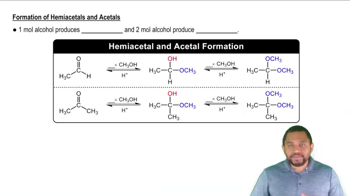
One mole of alcohol is needed to convert an aldehyde or ketone into a hemiacetal.
What is formed when a hemiacetal reacts with a second mole of alcohol?
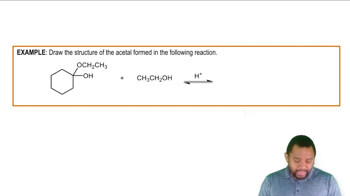
An acetal is formed, which has two alkoxy groups (OR) attached to the same carbon.
What happens to the hydroxy group (OH) during acetal formation?
The hydroxy group (OH) is replaced by an alkoxy group (OR) when a second mole of alcohol is added.
Which types of compounds can react with alcohols to form hemiacetals and acetals?
Both aldehydes and ketones can react with alcohols to form hemiacetals and acetals.
What attaches to the carbonyl carbon during hemiacetal formation?
The alkoxy portion (OR) of the alcohol attaches to the carbonyl carbon.
What happens to the oxygen of the carbonyl group during hemiacetal formation?
The oxygen of the carbonyl group becomes a hydroxy group (OH).
How many alkoxy groups are present on the carbon in an acetal?
There are two alkoxy groups (OR) on the same carbon in an acetal.
Why can't the carbonyl carbon form more than four bonds during acetal formation?
Carbon can only make up to four bonds, so the OH group must leave to allow a second OR group to attach.
What is the difference between a hemiacetal and an acetal in terms of their structure?
A hemiacetal has one OH and one OR group on the same carbon, while an acetal has two OR groups.
What is the role of the second mole of alcohol in acetal formation?
The second mole of alcohol provides the second OR group, replacing the OH group on the hemiacetal.
Can both aldehydes and ketones form acetals?
Yes, both aldehydes and ketones can form acetals after reacting with two moles of alcohol.
What is the initial product when an aldehyde or ketone reacts with one mole of alcohol?
The initial product is a hemiacetal.
What must happen for a hemiacetal to become an acetal?
A second mole of alcohol must react with the hemiacetal, replacing the OH group with an OR group.
 BackBack

 2:17
2:17