Skip to main content
GOB Chemistry
My Course
Learn
Exam Prep
AI Tutor
Study Guides
Textbook Solutions
Flashcards
Explore
Try the app
My Course
Learn
Exam Prep
AI Tutor
Study Guides
Textbook Solutions
Flashcards
Explore
Try the app
Back
Hemiacetal and Acetal Formation definitions
You can tap to flip the card.
Aldehyde
You can tap to flip the card.
👆
Aldehyde
A molecule featuring a carbonyl group bonded to at least one hydrogen, serving as a key reactant in hemiacetal formation.
Track progress
Control buttons has been changed to "navigation" mode.
1/13
Related flashcards
Related practice
Recommended videos
Hemiacetal and Acetal Formation quiz
Hemiacetal and Acetal Formation
15 Terms
Hemiacetal and Acetal Formation
15. Aldehydes and Ketones
1 problem
Topic
Laura
Reduction of Aldehydes and Ketones
15. Aldehydes and Ketones
5 problems
Topic
Jules
15. Aldehydes and Ketones
5 topics
13 problems
Chapter
Jules
Guided course
2:17
Formation of Hemiacetals and Acetals Concept 2
1
views
Guided course
1:49
Hemiacetals and Acetals Concept 1
1
views
Guided course
1:08
Formation of Hemiacetals and Acetals Example 2
1
views
Terms in this set (13)
Hide definitions
Aldehyde
A molecule featuring a carbonyl group bonded to at least one hydrogen, serving as a key reactant in hemiacetal formation.
Ketone
A compound with a carbonyl group bonded to two carbon atoms, participating in reactions with alcohols to yield hemiacetals.
Alcohol
A molecule containing a hydroxy group, providing the alkoxy portion that attaches to the carbonyl carbon during these reactions.
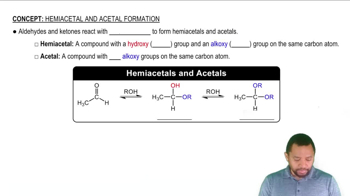
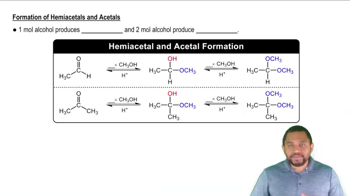
Hemiacetal
A structure with both a hydroxy group and an alkoxy group attached to the same carbon, formed from one mole of alcohol and a carbonyl compound.
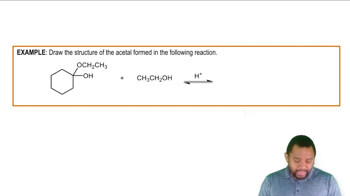
Acetal
A compound where two alkoxy groups are bonded to the same carbon, resulting from the reaction of a hemiacetal with a second mole of alcohol.
Hydroxy Group
An -OH functional group, present on the central carbon in hemiacetals and replaced during acetal formation.
Alkoxy Group
An -OR group derived from alcohol, attached to the central carbon in both hemiacetals and acetals.
Carbonyl Carbon
The central carbon atom of an aldehyde or ketone, which becomes the attachment site for new groups during these transformations.
Mole
A unit representing the amount of alcohol added, determining whether a hemiacetal or acetal is produced.
R Group
A variable carbon-containing substituent, which can be a chain, ring, or other structure, represented as 'R' in chemical formulas.
Bond
A connection between atoms, with carbon limited to four, influencing the replacement of groups during acetal formation.
Functional Group
A specific group of atoms within molecules, such as hydroxy or alkoxy, that determines chemical reactivity.
Transformation
The process by which functional groups on the carbonyl carbon are replaced or added during these reactions.
 BackBack

 2:17
2:17