Back

Energy Production In Biochemical Pathways quiz

Control buttons has been changed to "navigation" mode.
1/15
  • What are the two main methods biochemical systems use to produce energy?

    Biochemical systems primarily use oxidation reactions and cleavage/hydrolysis to produce energy.
  • What is produced during oxidation reactions in biochemical pathways?

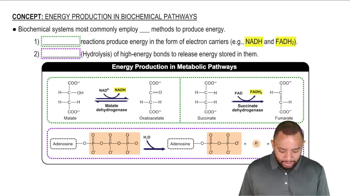
    Oxidation reactions produce energy in the form of electron carriers such as NADH and FADH2.
  • Which enzyme catalyzes the conversion of malate to oxaloacetate in the citric acid cycle?

    Malate dehydrogenase catalyzes the conversion of malate to oxaloacetate.
  • In step 8 of the citric acid cycle, what happens to NAD+?

    NAD+ is reduced to NADH during the conversion of malate to oxaloacetate.
  • What type of reaction is catalyzed by dehydrogenase enzymes?

    Dehydrogenase enzymes catalyze oxidation reactions.
  • During the conversion of succinate to fumarate, which electron carrier is reduced?

    FAD is reduced to FADH2 during the conversion of succinate to fumarate.
  • What structural change occurs when succinate is converted to fumarate?

    A pi bond is created between two carbons, transforming succinate into fumarate.
  • What is the role of FAD in the citric acid cycle?

    FAD acts as an electron carrier, being reduced to FADH2 during oxidation reactions.
  • What is a cleavage or hydrolysis reaction in biochemical energy production?

    It is the breaking of high-energy bonds, such as phosphate bonds in ATP, to release stored energy.
  • How is energy released from ATP?

    Energy is released from ATP by hydrolysis, where water breaks a phosphate bond, releasing inorganic phosphate.
  • What are the products of ATP hydrolysis?

    ATP hydrolysis produces ADP and inorganic phosphate, releasing energy.
  • Why are oxidation reactions important in biochemical pathways?

    They generate electron carriers like NADH and FADH2, which are crucial for energy transfer.
  • What is the significance of electron carriers in energy production?

    Electron carriers like NADH and FADH2 transfer energy within the cell for ATP synthesis.
  • What happens to water during ATP hydrolysis?

    Water is added to ATP, breaking a phosphate bond and releasing energy.
  • Which two steps in the citric acid cycle involve oxidation reactions discussed in the lesson?

    Step 6 (succinate to fumarate) and step 8 (malate to oxaloacetate) involve oxidation reactions.