Back

Energy Production In Biochemical Pathways definitions

Control buttons has been changed to "navigation" mode.
1/15
  • Oxidation Reaction

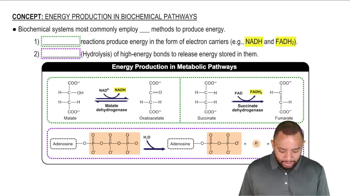
    Process where electrons are transferred, resulting in the formation of energy-rich molecules like NADH and FADH2.
  • Electron Carrier

    Molecule that temporarily holds electrons during energy transfer, crucial for cellular energy production.
  • NADH

    Reduced form of a coenzyme that stores high-energy electrons for use in cellular respiration.
  • FADH2

    Reduced electron carrier formed during the citric acid cycle, essential for transferring electrons to the electron transport chain.
  • Citric Acid Cycle

    Series of biochemical reactions that generate electron carriers and intermediates for energy production.
  • Malate

    Intermediate in the citric acid cycle, converted to oxaloacetate by a specific dehydrogenase enzyme.
  • Oxaloacetate

    Four-carbon molecule regenerated in the citric acid cycle, essential for its continuation.
  • Malate Dehydrogenase

    Enzyme that catalyzes the oxidation of malate to oxaloacetate, producing NADH.
  • Succinate

    Intermediate in the citric acid cycle, transformed into fumarate with the help of a dehydrogenase.
  • Fumarate

    Product of succinate oxidation, contains a newly formed pi bond between two carbons.
  • Dehydrogenase

    Enzyme class responsible for catalyzing oxidation reactions by transferring electrons to carriers.
  • Cleavage Reaction

    Biochemical process involving the breaking of chemical bonds, often releasing stored energy.
  • Hydrolysis

    Reaction where water is used to break high-energy bonds, such as those in ATP, releasing energy.
  • Phosphate Bond

    High-energy linkage in molecules like ATP, whose breakage releases usable cellular energy.
  • Inorganic Phosphate

    Molecule released upon ATP hydrolysis, contributing to the energy output of the reaction.