GOB Chemistry
My Course
Learn
Exam Prep
AI Tutor
Study Guides
Textbook Solutions
Flashcards
Explore
Try the app
My Course
Learn
Exam Prep
AI Tutor
Study Guides
Textbook Solutions
Flashcards
Explore
Try the app
Back
Digestion of Proteins quiz
You can tap to flip the card.
What is the main purpose of protein digestion?
You can tap to flip the card.
👆
What is the main purpose of protein digestion?
The main purpose is to break down proteins into amino acids for the synthesis of new proteins.
Track progress
Control buttons has been changed to "navigation" mode.
1/15
Related flashcards
Related practice
Recommended videos
Digestion of Proteins definitions
Digestion of Proteins
13 Terms
Digestion of Proteins
25. Protein and Amino Acid Metabolism
3 problems
Topic

Laura
Intro to Amino Acid Catabolism
25. Protein and Amino Acid Metabolism
2 problems
Topic
Nicole
25. Protein and Amino Acid Metabolism
6 topics
12 problems
Chapter
KeyshawnDavis
Guided course
1:17
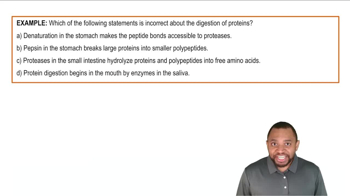
Digestion of Proteins Example 1
Guided course
2:01
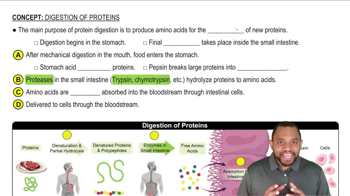
Digestion of Proteins Concept 1
1
views
Terms in this set (15)
Hide definitions
What is the main purpose of protein digestion?
The main purpose is to break down proteins into amino acids for the synthesis of new proteins.
Where does protein digestion begin?
Protein digestion begins in the stomach.
Where is the final hydrolysis of proteins completed?
Final hydrolysis of proteins is completed in the small intestine.
What happens to proteins in the stomach during digestion?
Stomach acid denatures proteins, and pepsin breaks them into polypeptides.
Which enzyme in the stomach is responsible for breaking down proteins?
Pepsin is the enzyme in the stomach that breaks down proteins into polypeptides.
What is the role of stomach acid in protein digestion?
Stomach acid denatures proteins, making them easier for enzymes to break down.
What are the main proteases in the small intestine involved in protein digestion?
Trypsin and chymotrypsin are the main proteases in the small intestine.
What do proteases in the small intestine do to polypeptides?
Proteases hydrolyze polypeptides into free amino acids.
How are amino acids absorbed after protein digestion?
Amino acids are absorbed into the bloodstream through the intestinal cells.
What is the sequence of events in protein digestion as described by points a, b, c, and d?
A: Denaturation and partial hydrolysis in the stomach; B: Enzyme action in the small intestine; C: Absorption of amino acids; D: Delivery to cells.
What is the function of pepsin in the stomach?
Pepsin breaks large proteins into smaller polypeptides.
What happens to proteins after they are denatured in the stomach?
They are partially hydrolyzed into polypeptides by pepsin.
What is the fate of free amino acids after absorption?
They are delivered to various cells in the body via the bloodstream.
Which part of protein digestion involves absorption through intestinal cells?
Part C involves the absorption of amino acids through intestinal cells.
Why is mechanical digestion in the mouth important for protein digestion?
Mechanical digestion breaks food into smaller pieces, making it easier for stomach acid and enzymes to act on proteins.