Skip to main content
GOB Chemistry
My Course
Learn
Exam Prep
AI Tutor
Study Guides
Textbook Solutions
Flashcards
Explore
Try the app
My Course
Learn
Exam Prep
AI Tutor
Study Guides
Textbook Solutions
Flashcards
Explore
Try the app
Back
Digestion of Lipids quiz
You can tap to flip the card.
What happens to triacylglycerols (TAGs) after hydrolysis in the small intestine?
You can tap to flip the card.
👆
What happens to triacylglycerols (TAGs) after hydrolysis in the small intestine?
TAGs are broken down into monoacylglycerols and fatty acids by pancreatic lipases, which are then absorbed into intestinal cells.
Track progress
Control buttons has been changed to "navigation" mode.
1/15
Related flashcards
Related practice
Recommended videos
Digestion of Lipids definitions
Digestion of Lipids
13 Terms
Digestion of Lipids
24. Lipid Metabolism
3 problems
Topic
Nicole
Lipoproteins for Transport
24. Lipid Metabolism
5 problems
Topic
Nicole
24. Lipid Metabolism - Part 1 of 2
8 topics
15 problems
Chapter
KeyshawnDavis
24. Lipid Metabolism - Part 2 of 2
1 topic
3 problems
Chapter
Nicole
Guided course
1:41
Digestion of Lipids Example 1
Guided course
2:48
Digestion of Lipids Concept 1
1
views
Terms in this set (15)
Hide definitions
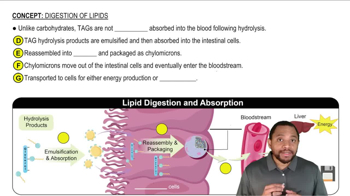
What happens to triacylglycerols (TAGs) after hydrolysis in the small intestine?
TAGs are broken down into monoacylglycerols and fatty acids by pancreatic lipases, which are then absorbed into intestinal cells.
Which enzyme is responsible for breaking ester linkages in TAGs during lipid digestion?
Pancreatic lipases break the ester linkages in TAGs during digestion in the small intestine.
What is the main product formed after TAG hydrolysis in the small intestine?
The main product is monoacylglycerol, along with fatty acids.
What process helps monoacylglycerols and fatty acids enter intestinal cells?
Emulsification aids the absorption of monoacylglycerols and fatty acids into intestinal cells.
What happens to monoacylglycerols inside intestinal cells during lipid digestion?
Monoacylglycerols are reassembled into TAGs within the intestinal cells.
How are reassembled TAGs transported from intestinal cells?
Reassembled TAGs are packaged into chylomicrons for transport.
What is a chylomicron?
A chylomicron is a lipoprotein particle that transports TAGs from intestinal cells into the bloodstream.
What is the next step after chylomicrons are formed in intestinal cells?
Chylomicrons exit the intestinal cells and enter the bloodstream.
Where do chylomicrons go after entering the bloodstream?
Chylomicrons are transported to various cells for energy production or storage.
Which cells use chylomicrons for energy production?
Liver and skeletal muscle cells use chylomicrons for energy production.
What happens to chylomicrons in adipose cells?
Chylomicrons are stored in adipose cells for later use.
What analogy is used to describe the storage function of adipose cells?
Adipose cell storage is compared to a floppy disk, representing a form of storage.
Why are TAGs not directly absorbed into the blood after hydrolysis?
TAGs must first be broken down and reassembled before they can be transported in the blood.
What are the two main fates of chylomicrons after entering the bloodstream?
Chylomicrons are either used for energy production or stored in adipose cells.
What role do fatty acids from TAGs play in energy production?
Fatty acids from TAGs are used by cells like the liver and skeletal muscle to produce energy.
 BackBack
 1:41
1:41