Skip to main content
GOB Chemistry
My Course
Learn
Exam Prep
AI Tutor
Study Guides
Textbook Solutions
Flashcards
Explore
Try the app
My Course
Learn
Exam Prep
AI Tutor
Study Guides
Textbook Solutions
Flashcards
Explore
Try the app
Back
Digestion of Lipids definitions
You can tap to flip the card.
Triacylglycerols
You can tap to flip the card.
👆
Triacylglycerols
Major dietary fats broken down during digestion, yielding molecules that can be absorbed by intestinal cells.
Track progress
Control buttons has been changed to "navigation" mode.
1/13
Related flashcards
Related practice
Recommended videos
Digestion of Lipids quiz
Digestion of Lipids
15 Terms
Digestion of Lipids
24. Lipid Metabolism
3 problems
Topic
Nicole
Lipoproteins for Transport
24. Lipid Metabolism
5 problems
Topic
Nicole
24. Lipid Metabolism - Part 1 of 2
8 topics
15 problems
Chapter
KeyshawnDavis
24. Lipid Metabolism - Part 2 of 2
1 topic
3 problems
Chapter
Nicole
Guided course
1:41
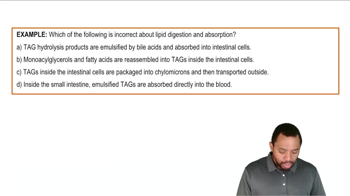
Digestion of Lipids Example 1
Guided course
2:48
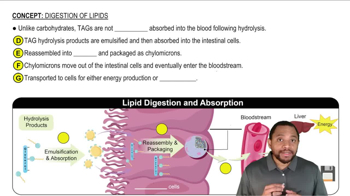
Digestion of Lipids Concept 1
1
views
Terms in this set (13)
Hide definitions
Triacylglycerols
Major dietary fats broken down during digestion, yielding molecules that can be absorbed by intestinal cells.
Monoacylglycerols
Hydrolysis products formed after ester linkages in fats are severed, ready for absorption in the intestine.
Ester Linkages
Chemical bonds in fats that are broken by enzymes to release absorbable lipid fragments.
Pancreatic Lipases
Digestive enzymes in the small intestine responsible for breaking down fats into absorbable units.
Emulsification
Process that increases the surface area of fat droplets, aiding their breakdown and absorption.
Intestinal Cells
Sites within the digestive tract where lipid absorption and reassembly into larger fat molecules occur.
Chylomicrons
Lipoprotein particles that transport reassembled fats from the intestine into the bloodstream.
Bloodstream
Transport network that distributes absorbed and packaged fats to various tissues for energy or storage.
Liver
Organ that can receive transported fats for energy production after their absorption and packaging.
Skeletal Muscle
Tissue capable of utilizing transported fats for immediate energy needs.
Adipose Cells
Specialized storage sites for fats, compared to floppy disks for their role in energy reserve.
Storage
Process where excess fats are kept in specialized cells for future energy requirements.
Hydrolysis
Chemical reaction that splits fats into smaller, absorbable molecules using water and enzymes.
 BackBack
 1:41
1:41