Back

Chemistry Gas Laws: Combined Gas Law quiz

Control buttons has been changed to "navigation" mode.
1/15
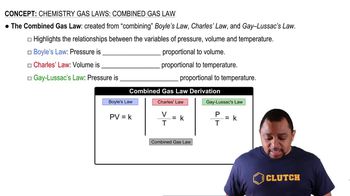
  • What three individual gas laws are combined to form the combined gas law?

    Boyle's law, Charles' law, and Gay Lussac's law are combined to form the combined gas law.
  • What variables does the combined gas law relate?

    The combined gas law relates pressure, volume, and temperature.
  • According to Boyle's law, how are pressure and volume related?

    Boyle's law states that pressure is inversely proportional to volume.
  • How does Charles' law relate volume and temperature?

    Charles' law states that volume is directly proportional to temperature.
  • What is the relationship between pressure and temperature in Gay Lussac's law?

    Gay Lussac's law states that pressure is directly proportional to temperature.
  • What is the mathematical formula for the combined gas law?

    The formula is PV/T = k, where k is a constant.
  • How can the combined gas law be used to compare two different states of a gas?

    It can be used as P1V1/T1 = P2V2/T2 to compare two sets of conditions.
  • In the combined gas law formula, what does the constant 'k' represent?

    The constant 'k' represents a constant value for a given amount of gas.
  • If temperature increases and pressure remains constant, what happens to volume according to the combined gas law?

    Volume increases as temperature increases if pressure is constant.
  • If volume decreases and temperature is constant, what happens to pressure?

    Pressure increases as volume decreases if temperature is constant.
  • What must remain constant for the combined gas law to apply?

    The amount of gas (number of moles) must remain constant.
  • How is the combined gas law derived from the individual gas laws?

    It is derived by combining the relationships from Boyle's, Charles', and Gay Lussac's laws.
  • What does the numerator and denominator represent in the combined gas law formula PV/T?

    Pressure and volume are in the numerator, and temperature is in the denominator.
  • If you know the initial and final pressure, volume, and temperature, how can you solve for an unknown variable?

    You can rearrange P1V1/T1 = P2V2/T2 to solve for the unknown variable.
  • Why is the combined gas law useful in chemistry?

    It allows you to solve problems involving changes in pressure, volume, and temperature for a fixed amount of gas.