Back

Chemistry Gas Laws: Combined Gas Law definitions

Control buttons has been changed to "navigation" mode.
1/14
  • Combined Gas Law

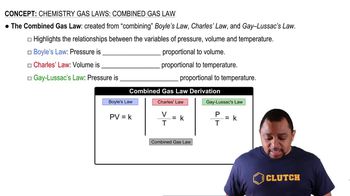
    An equation relating pressure, volume, and temperature, derived from integrating three foundational gas laws.
  • Boyle's Law

    A principle stating that pressure and volume of a gas are inversely related when temperature is constant.
  • Charles' Law

    A principle showing that volume and temperature of a gas are directly related at constant pressure.
  • Gay Lussac's Law

    A principle indicating that pressure and temperature of a gas are directly related at constant volume.
  • Pressure

    A variable representing the force exerted by gas particles per unit area within a container.
  • Volume

    A variable indicating the amount of three-dimensional space occupied by a gas.
  • Temperature

    A variable reflecting the average kinetic energy of gas particles, affecting both pressure and volume.
  • Proportionality

    A mathematical relationship describing how one variable changes in response to another in gas laws.
  • Constant (k)

    A fixed value representing the ratio of pressure and volume to temperature for a given amount of gas.
  • Numerator

    The part of a fraction in the combined gas law formula representing pressure and volume.
  • Denominator

    The part of a fraction in the combined gas law formula representing temperature.
  • PV/T Formula

    An expression showing the relationship among pressure, volume, and temperature in the combined gas law.
  • Direct Relationship

    A connection where an increase in one variable causes an increase in another, as seen in Charles' and Gay Lussac's laws.
  • Inverse Relationship

    A connection where an increase in one variable causes a decrease in another, as described by Boyle's law.