Back

Coenzymes in Metabolism quiz

Control buttons has been changed to "navigation" mode.
1/15
  • What is the driving force of catabolism in metabolic reactions?

    The driving force is the oxidation of molecules to release energy.
  • How do coenzymes facilitate energy release in metabolism?

    Coenzymes cycle between oxidized and reduced forms, carrying electrons that are ultimately used to form ATP.
  • What role do reduced forms of coenzymes play?

    Reduced coenzymes act as electron carriers, transferring energy to ATP bonds.
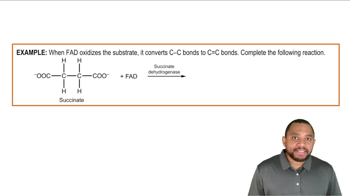
  • What happens to a substrate during oxidation in metabolism?

    The substrate loses its hydrogen, which is transferred to the coenzyme.
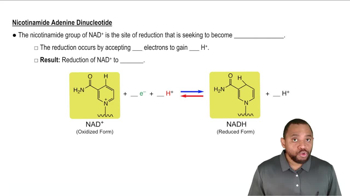
  • What is the oxidized form of Nicotinamide Adenine Dinucleotide called?

    The oxidized form is NAD+.
  • How is NAD+ reduced to NADH?

    NAD+ accepts 2 electrons and 1 hydrogen, resulting in NADH and one leftover H+.
  • What change occurs at the nitrogen atom in NAD+ during reduction?

    The nitrogen loses its positive charge and becomes neutral with a lone pair.
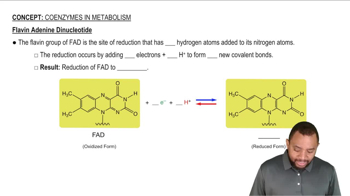
  • What is the reduced form of Flavin Adenine Dinucleotide?

    The reduced form is FADH2.
  • How is FAD reduced to FADH2?

    FAD is reduced by adding 2 electrons and 2 H+ to its nitrogen atoms, forming two new covalent bonds.
  • What structural change occurs in FAD during reduction?

    Pi bonds shift at the nitrogen sites as two hydrogens are added.
  • What is the function of Coenzyme A in metabolism?

    Coenzyme A carries an acetyl group to the Krebs Cycle for energy production.
  • What type of bond does Coenzyme A contain that is considered high energy?

    Coenzyme A contains a high-energy thiol (SH) bond.
  • What are the three components of Coenzyme A?

    Coenzyme A is composed of ADP, pantothenic acid (vitamin B5), and aminoethanethiol.
  • Which portion of Coenzyme A is responsible for its high-energy bond?

    The aminoethanethiol portion contains the SH group responsible for the high-energy bond.
  • What is another name for pantothenic acid found in Coenzyme A?

    Pantothenic acid is also known as vitamin B5.