What are the two main processes involved in amino acid catabolism in the liver?
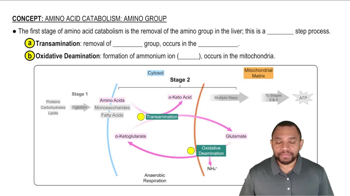
The two main processes are transamination and oxidative deamination.
What is the purpose of transamination in amino acid catabolism?
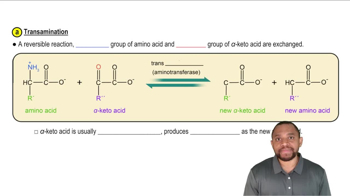
Transamination exchanges the amino group of an amino acid with the keto group of an alpha-keto acid, forming glutamate and a new alpha-keto acid.
Which enzyme facilitates the transamination reaction?
The enzyme transaminase, also called aminotransferase, facilitates transamination.
What is the key product formed during transamination?
The key product is glutamate, which is formed from alpha-ketoglutarate.
Where does transamination primarily occur within the cell?
Transamination occurs in the cytosol.
What is the second stage of amino acid catabolism after transamination?
The second stage is oxidative deamination.
Which enzyme is responsible for oxidative deamination?
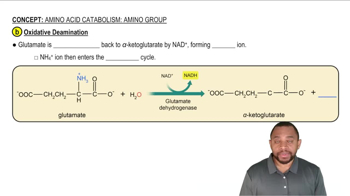
Glutamate dehydrogenase is responsible for oxidative deamination.
What molecule is reduced during oxidative deamination?
NAD+ is reduced to NADH during oxidative deamination.
What are the products of oxidative deamination?
The products are alpha-ketoglutarate and an ammonium ion (NH4+).
Where does oxidative deamination occur within the cell?
Oxidative deamination occurs in the mitochondrial matrix.
What happens to the ammonium ion produced during oxidative deamination?
The ammonium ion enters the urea cycle.
Is the transamination reaction reversible or irreversible?
Transamination is a reversible reaction.
What is typically the alpha-keto acid involved in transamination?
The alpha-keto acid is usually alpha-ketoglutarate.
What is the role of NAD+ in oxidative deamination?
NAD+ acts as an electron acceptor and is reduced to NADH, enabling the oxidation of glutamate.
How do transamination and oxidative deamination relate to the mitochondrial membrane?
These processes involve movement across the mitochondrial membrane, with transamination in the cytosol and oxidative deamination in the mitochondrial matrix.