Back

Amino Acid Catabolism: Amino Group definitions

Control buttons has been changed to "navigation" mode.
1/15
  • Transamination

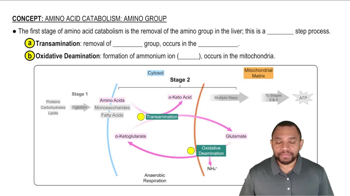
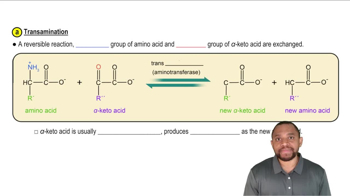
    A reversible process exchanging an amino group with a keto group between amino acids and alpha-keto acids, catalyzed by transaminase.
  • Oxidative Deamination

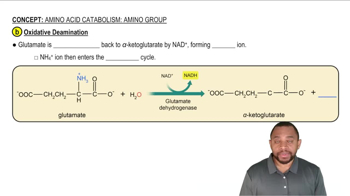
    A reaction where glutamate is oxidized to alpha-ketoglutarate, releasing an ammonium ion and involving NAD+ reduction.
  • Amino Group

    A functional group containing nitrogen, removed from amino acids during catabolism in the liver.
  • Alpha-Keto Acid

    A molecule with a keto group adjacent to a carboxyl group, formed during transamination.
  • Glutamate

    An amino acid produced during transamination, serving as a key intermediate in amino group removal.
  • Alpha-Ketoglutarate

    A compound regenerated from glutamate during oxidative deamination, central to amino acid metabolism.
  • Ammonium Ion

    A positively charged ion (NH4+) produced during oxidative deamination, entering the urea cycle.
  • Transaminase

    An enzyme that catalyzes the exchange of amino and keto groups between amino acids and alpha-keto acids.
  • Glutamate Dehydrogenase

    An enzyme facilitating the oxidation of glutamate to alpha-ketoglutarate, producing ammonium ion.
  • NAD+

    A coenzyme acting as an electron acceptor, reduced to NADH during oxidative deamination.
  • NADH

    A high-energy molecule formed when NAD+ is reduced during the oxidation of glutamate.
  • Urea Cycle

    A metabolic pathway where ammonium ions are converted to urea for excretion.
  • Mitochondrial Matrix

    The compartment within mitochondria where oxidative deamination and parts of transamination occur.
  • Cytosol

    The fluid portion of the cell where initial steps of amino acid catabolism, such as transamination, take place.
  • Mitochondrial Membrane

    A barrier traversed during amino acid catabolism, separating cytosolic and mitochondrial processes.