Payne, B. A. et al. (2013) present evidence that a low level of heteroplasmic mtDNA exists in all tested healthy individuals.
What genetic conditions within a given mitochondrion are likely to contribute to such a variable pool of mitochondria?

Verified step by step guidance
Payne, B. A. et al. (2013) present evidence that a low level of heteroplasmic mtDNA exists in all tested healthy individuals.
What genetic conditions within a given mitochondrion are likely to contribute to such a variable pool of mitochondria?
Payne, B. A. et al. (2013) present evidence that a low level of heteroplasmic mtDNA exists in all tested healthy individuals.
What are two likely sources of such heteroplasmy?
The mtDNA accumulates mutations at a rate approximately ten times faster than nuclear DNA. Thus geneticists can use mtDNA variations as a 'molecular clock' to study genetic variation and the movement of ancestral human populations from Africa to different areas of the world more than 125,000 years ago. Propose an explanation for how an analysis of mtDNA can be used to construct family trees of human evolution.
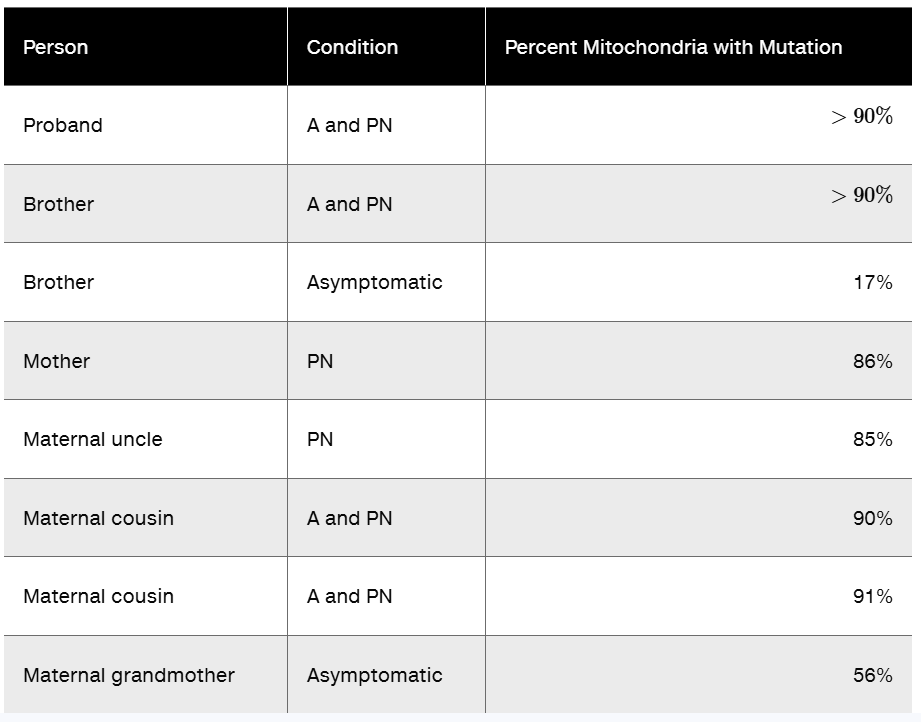
Researchers examined a family with an interesting distribution of Leigh syndrome symptoms. In this disorder, individuals may show a progressive loss of motor function (ataxia, A) with peripheral neuropathy (PN, meaning impairment of the peripheral nerves). A mitochondrial DNA (mtDNA) mutation that reduces ATPase activity was identified in various tissues of affected individuals. The accompanying table summarizes the presence of symptoms in an extended family.
How can some individuals in the same family show such variation in symptoms? What term, as related to organelle heredity, describes such variation?
Researchers examined a family with an interesting distribution of Leigh syndrome symptoms. In this disorder, individuals may show a progressive loss of motor function (ataxia, A) with peripheral neuropathy (PN, meaning impairment of the peripheral nerves). A mitochondrial DNA (mtDNA) mutation that reduces ATPase activity was identified in various tissues of affected individuals. The accompanying table summarizes the presence of symptoms in an extended family.
Develop a pedigree that summarizes the information presented in the table.
Researchers examined a family with an interesting distribution of Leigh syndrome symptoms. In this disorder, individuals may show a progressive loss of motor function (ataxia, A) with peripheral neuropathy (PN, meaning impairment of the peripheral nerves). A mitochondrial DNA (mtDNA) mutation that reduces ATPase activity was identified in various tissues of affected individuals. The accompanying table summarizes the presence of symptoms in an extended family.
Provide an explanation for the pattern of inheritance of the disease. What term describes this pattern?