Payne, B. A. et al. (2013) present evidence that a low level of heteroplasmic mtDNA exists in all tested healthy individuals.
What genetic conditions within a given mitochondrion are likely to contribute to such a variable pool of mitochondria?

Verified step by step guidance
Payne, B. A. et al. (2013) present evidence that a low level of heteroplasmic mtDNA exists in all tested healthy individuals.
What genetic conditions within a given mitochondrion are likely to contribute to such a variable pool of mitochondria?
Payne, B. A. et al. (2013) present evidence that a low level of heteroplasmic mtDNA exists in all tested healthy individuals.
What are two likely sources of such heteroplasmy?
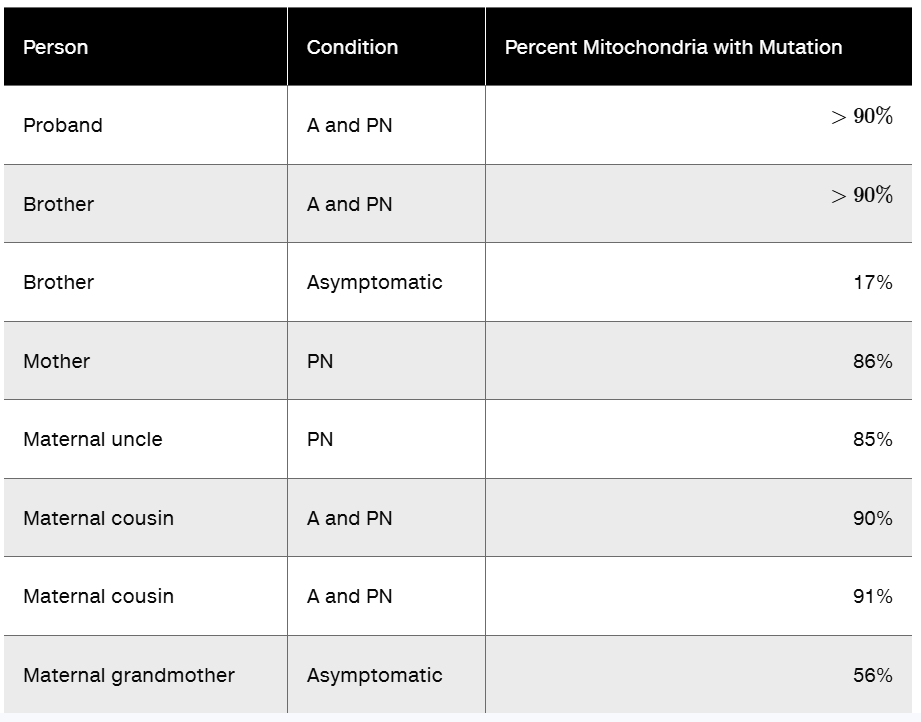
Researchers examined a family with an interesting distribution of Leigh syndrome symptoms. In this disorder, individuals may show a progressive loss of motor function (ataxia, A) with peripheral neuropathy (PN, meaning impairment of the peripheral nerves). A mitochondrial DNA (mtDNA) mutation that reduces ATPase activity was identified in various tissues of affected individuals. The accompanying table summarizes the presence of symptoms in an extended family.
Develop a pedigree that summarizes the information presented in the table.
Researchers examined a family with an interesting distribution of Leigh syndrome symptoms. In this disorder, individuals may show a progressive loss of motor function (ataxia, A) with peripheral neuropathy (PN, meaning impairment of the peripheral nerves). A mitochondrial DNA (mtDNA) mutation that reduces ATPase activity was identified in various tissues of affected individuals. The accompanying table summarizes the presence of symptoms in an extended family.
In what way does a condition caused by mtDNA differ in expression and transmission from a mutation that causes albinism?
Researchers examined a family with an interesting distribution of Leigh syndrome symptoms. In this disorder, individuals may show a progressive loss of motor function (ataxia, A) with peripheral neuropathy (PN, meaning impairment of the peripheral nerves). A mitochondrial DNA (mtDNA) mutation that reduces ATPase activity was identified in various tissues of affected individuals. The accompanying table summarizes the presence of symptoms in an extended family.
Provide an explanation for the pattern of inheritance of the disease. What term describes this pattern?
Mutations in mitochondrial DNA appear to be responsible for a number of neurological disorders, including myoclonic epilepsy and ragged-red fiber disease, Leber's hereditary optic neuropathy, and Kearns-Sayre syndrome. In each case, the disease phenotype is expressed when the ratio of mutant to wild-type mitochondria exceeds a threshold peculiar to each disease, but usually in the 60 to 95 percent range.
Compared with the vast number of mitochondria in an embryo, the number of mitochondria in an ovum is relatively small. Might such an ooplasmic mitochondrial bottleneck present an opportunity for therapy or cure? Explain.