Back

Chromosomal Rearrangements: Duplications quiz

Control buttons has been changed to "navigation" mode.
1/15
  • What is a chromosomal duplication?

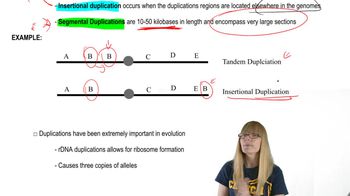
    A chromosomal duplication is when a segment of a chromosome is doubled, resulting in extra genetic material.
  • What is a tandem duplication?

    A tandem duplication is when the duplicated chromosomal segment is located directly adjacent to the original segment.
  • What is an insertional duplication?

    An insertional duplication is when the duplicated segment is located elsewhere in the genome, not adjacent to the original, and can even be on a different chromosome.
  • How large are segmental duplications typically?

    Large segmental duplications usually span 10 to 50 kilobases of DNA.
  • Are large segmental duplications common in all organisms?

    No, large segmental duplications are rare and mainly occur in a few specific organisms.
  • Why are duplications important for evolution?

    Duplications provide extra genetic material that can mutate and potentially lead to beneficial evolutionary changes.
  • What is rDNA and why is its duplication important?

    rDNA encodes ribosomal RNA, which is essential for ribosome production; its duplication ensures enough ribosomes are made for protein synthesis and survival.
  • What would happen if humans had only one copy of the rDNA gene?

    If humans had only one copy of the rDNA gene, they would not be able to produce enough ribosomes to survive.
  • How does duplication affect the number of alleles for a gene?

    Duplication can result in three copies of an allele instead of the usual two.
  • Why are the original two alleles of a gene usually conserved?

    The original two alleles are required for essential functions, so they are conserved to maintain the organism's survival.
  • What evolutionary advantage does a third, duplicated allele provide?

    The third allele is not essential and can accumulate mutations, some of which may become beneficial over time.
  • Can insertional duplications occur on different chromosomes?

    Yes, insertional duplications can occur on the same or different chromosomes.
  • What is the relationship between gene duplication and protein synthesis?

    Gene duplication, such as of rDNA, increases the capacity for protein synthesis by providing more templates for ribosome production.
  • How do duplications contribute to genetic diversity?

    Duplications create extra genetic material that can evolve independently, increasing genetic diversity.
  • Do all mutations in duplicated alleles lead to beneficial traits?

    No, not all mutations are beneficial, but some can lead to new, useful traits for the organism.