Neither strontium (Sr) nor antimony (Sb) is shown in the activity series of Table 4.5. Based on their positions in the periodic table, which would you expect to be the better reducing agent? Will the following reaction occur? Explain.
Ch.4 - Reactions in Aqueous Solution
Chapter 4, Problem 120c
Use the activity series of metals (Table 4.5) to predict the outcome of each of the following reactions. If no reaction occurs, write NR. (c)
Verified step by step guidance1
Identify the metals and their ions involved in the reaction from the problem statement.
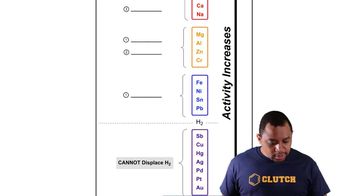
Refer to the activity series of metals (Table 4.5) to determine the reactivity order of the metals involved.
Compare the reactivity of the metal in its elemental form with the metal in its ionic form. A metal will only displace another metal from its compound if it is higher in the activity series.
If the elemental metal is more reactive than the metal ion it is reacting with, predict that a displacement reaction will occur. Write the balanced chemical equation for the reaction.
If the elemental metal is less reactive than the metal ion, predict that no reaction will occur and write 'NR' (No Reaction).

Verified video answer for a similar problem:
This video solution was recommended by our tutors as helpful for the problem above.
Video duration:
2mWas this helpful?
Key Concepts
Here are the essential concepts you must grasp in order to answer the question correctly.
Activity Series of Metals
The activity series of metals is a list that ranks metals based on their reactivity, from most reactive to least reactive. It helps predict whether a metal will displace another metal in a chemical reaction. For example, a metal higher in the series can displace a metal lower in the series from its compound, while no reaction occurs if the reverse is true.
Recommended video:
Guided course
Activity Series Chart
Single Replacement Reactions
Single replacement reactions occur when one element replaces another in a compound. This type of reaction can be predicted using the activity series; if the free element is more reactive than the element in the compound, a reaction will occur. If not, the result is no reaction (NR).
Recommended video:
Guided course
Single Displacement Reactions
Predicting Reaction Outcomes
To predict the outcome of a reaction using the activity series, one must compare the reactivity of the metals involved. If the metal attempting to displace another is higher in the series, the reaction will proceed, resulting in the formation of a new compound. If it is lower, the reaction will not occur, and NR is noted.
Recommended video:
Guided course
Calculating Predicted Mass
Related Practice
Textbook Question
Textbook Question
Which element is oxidized and which is reduced in each of the following reactions? (b)
Textbook Question
Use the activity series of metals (Table 4.5) to predict the outcome of each of the following reactions. If no reaction occurs, write NR. (a)
Textbook Question
Use the activity series of metals (Table 4.5) to predict the outcome of each of the following reactions. If no reaction occurs, write NR. (d)
Textbook Question
Use the activity series of metals (Table 4.5) to predict the outcome of each of the following reactions. If no reaction occurs, write NR. (b)
Textbook Question
(a) Use the following reactions to arrange the elements A, B, C, and D in order of their decreasing ability as reducing agents:
