Neither strontium (Sr) nor antimony (Sb) is shown in the activity series of Table 4.5. Based on their positions in the periodic table, which would you expect to be the better reducing agent? Will the following reaction occur? Explain.
Ch.4 - Reactions in Aqueous Solution
Chapter 4, Problem 122a
(a) Use the following reactions to arrange the elements A, B, C, and D in order of their decreasing ability as reducing agents:
Verified step by step guidance1
insert step 1
insert step 2
insert step 3
insert step 4
insert step 5

Verified video answer for a similar problem:
This video solution was recommended by our tutors as helpful for the problem above.
Video duration:
4mWas this helpful?
Key Concepts
Here are the essential concepts you must grasp in order to answer the question correctly.
Reducing Agents
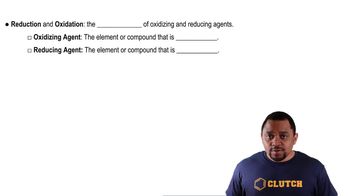
A reducing agent is a substance that donates electrons in a chemical reaction, thereby reducing another substance. The strength of a reducing agent is determined by its ability to lose electrons easily. Elements that are more electropositive, such as alkali metals, typically serve as stronger reducing agents because they readily give up their outermost electrons.
Recommended video:
Guided course
Oxidizing and Reducing Agents
Electrochemical Series
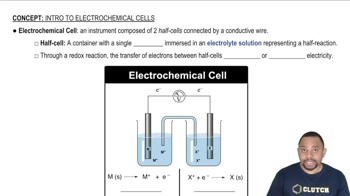
The electrochemical series is a list of elements arranged according to their standard electrode potentials. Elements higher in the series are stronger oxidizing agents, while those lower are stronger reducing agents. Understanding this series helps predict the reactivity of elements in redox reactions, allowing for the arrangement of reducing agents based on their relative strengths.
Recommended video:
Guided course
Electrochemical Cells
Redox Reactions
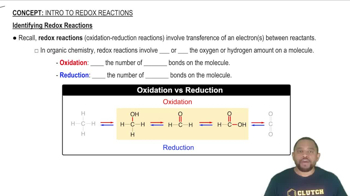
Redox reactions involve the transfer of electrons between two species, where one is oxidized (loses electrons) and the other is reduced (gains electrons). The ability of an element to act as a reducing agent is directly related to its tendency to undergo oxidation. Analyzing the half-reactions involved can clarify the order of reducing agents based on their electron-donating capabilities.
Recommended video:
Guided course
Identifying Redox Reactions
Related Practice
Textbook Question
Textbook Question
(a) Use the following reactions to arrange the elements A, B, C, and D in order of their decreasing ability as reducing agents:
Textbook Question
Use the activity series of metals (Table 4.5) to predict the outcome of each of the following reactions. If no reaction occurs, write NR. (d)
Textbook Question
(b) Which of the following reactions would you expect to occur according to the activity series you established in part (a)?
Textbook Question
(b) Which of the following reactions would you expect to occur according to the activity series you established in part (a)?
Textbook Question
Use the activity series of metals (Table 4.5) to predict the outcome of each of the following reactions. If no reaction occurs, write NR. (c)
