Consider the following table of standard electrode potentials for a series of hypothetical reactions in an aqueous solution: reduction half-reaction E °(V) (c) Which substance(s) can oxidize C2+?

Ch.20 - Electrochemistry

Brown15th EditionChemistry: The Central ScienceISBN: 9780137542970Not the one you use?Change textbook
Chapter 20, Problem 5
The standard reduction potential for the reduction of RuO4^-(aq) to RuO4^2-(aq) is +0.59 V. By using Appendix E, which of the following substances can oxidize RuO4^2-(aq) to RuO4^-(aq) under standard conditions: Br2(l), BrO3^-(aq), Mn^2+(aq), O2(g), Sn^2+(aq)?
Verified step by step guidance1
Step 1: Understand the problem by identifying the given standard reduction potential for the reduction of RuO_4^-(aq) to RuO_4^{2-}(aq), which is +0.59 V.
Step 2: Recognize that to determine which substances can oxidize RuO_4^{2-}(aq) to RuO_4^-(aq), we need to find substances with a higher standard reduction potential than +0.59 V.
Step 3: Use Appendix E to look up the standard reduction potentials for the given substances: Br2(l), BrO3^-(aq), Mn^{2+}(aq), O2(g), and Sn^{2+}(aq).
Step 4: Compare the standard reduction potentials of these substances to +0.59 V. A substance can oxidize RuO_4^{2-}(aq) if its standard reduction potential is greater than +0.59 V.
Step 5: Identify and list the substances with standard reduction potentials greater than +0.59 V, as these are capable of oxidizing RuO_4^{2-}(aq) to RuO_4^-(aq).
Key Concepts
Here are the essential concepts you must grasp in order to answer the question correctly.
Standard Reduction Potential
Standard reduction potential (E°) is a measure of the tendency of a chemical species to gain electrons and be reduced. It is measured in volts and is determined under standard conditions (1 M concentration, 1 atm pressure, and 25°C). A higher E° value indicates a greater ability to be reduced, while a lower value suggests a weaker tendency. In this question, the E° of +0.59 V for RuO4^-(aq) indicates that it can be reduced to RuO4^2-(aq) under standard conditions.
Recommended video:
Guided course
Standard Reduction Potentials
Oxidizing and Reducing Agents
An oxidizing agent is a substance that gains electrons in a chemical reaction, causing another substance to be oxidized. Conversely, a reducing agent loses electrons, facilitating the reduction of another species. To determine which substances can oxidize RuO4^2-(aq) to RuO4^-(aq), one must identify those with a higher standard reduction potential than +0.59 V, as they can effectively accept electrons from RuO4^2-(aq).
Recommended video:
Guided course
Oxidizing and Reducing Agents
Electrochemical Series
The electrochemical series is a list of standard reduction potentials for various half-reactions, arranged from the strongest oxidizing agents (highest E°) to the strongest reducing agents (lowest E°). This series allows chemists to predict the feasibility of redox reactions. By consulting this series, one can compare the E° values of the given substances (Br2, BrO3^-, Mn^2+, O2, Sn^2+) to determine which can oxidize RuO4^2-(aq) based on their respective potentials.
Recommended video:
Guided course
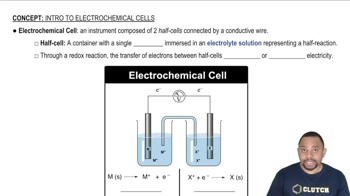
Electrochemical Cells
Related Practice
Textbook Question
Textbook Question
The diagram that follows represents a molecular view of a process occurring at an electrode in a voltaic cell.
(b) Is the electrode the anode or cathode?
1
views
Textbook Question
The diagram that follows represents a molecular view of a process occurring at an electrode in a voltaic cell.
(c) Why are the atoms in the electrode represented by larger spheres than those in the solution? [Section 20.3]
Textbook Question
Assume that you want to construct a voltaic cell that uses the following half-reactions: A2+1aq2 + 2 e- ¡ A1s2 Ered ° = -0.10 V B2+1aq2 + 2 e- ¡ B1s2 E°red = -1.10 V You begin with the incomplete cell pictured here in which the electrodes are immersed in water.
(a) What additions must you make to the cell for it to generate a standard emf?
1
views