
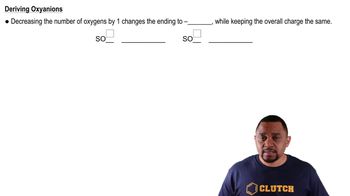
Elements in the same group of the periodic table often form oxyanions with the same general formula. The anions are also named in a similar fashion. Based on these observations, suggest a chemical formula or name, as appropriate, for each of the following ions: (d) hydrogen tellurate ion.

Give the chemical names of each of the following familiar compounds: (a) NaCl (table salt) (b) NaHCO3 (baking soda) (c) NaOCl (in many bleaches) (d) NaOH (caustic soda) (e) (NH4)2CO3 (smelling salts) (f) CaSO4 (plaster of Paris).
Verified step by step guidanceKey Concepts
Ionic Compounds
Common Nomenclature
Polyatomic Ions
Fill in the blanks in the following table:
Cation Anion Formula Name
Lithium oxide
Fe2+ PO43-
Al2(SO4)3
Copper(II) nitrate
Cr3+ I−
MnClO2
Ammonium carbonate
Zinc perchlorate
Complete the third column of the table.
Complete the fourth column of the table.
Many familiar substances have common, unsystematic names. For each of the following, give the correct systematic name: (a) salt peter, KNO3 (b) soda ash, Na2CO3 (c) lime, (d) muriatic acid, HCl, CaO (e) Epsom salts, MgSO4 (f) milk of magnesia, Mg(OH)2.
Elements in the same group of the periodic table often form oxyanions with the same general formula. The anions are also named in a similar fashion. Based on these observations, suggest a chemical formula or name, as appropriate, for each of the following ions: (a) BrO4- (b) SeO32- (c) arsenate ion
Because many ions and compounds have very similar names, there is great potential for confusing them. Write the correct chemical formulas to distinguish between (a) sodium carbonate and sodium bicarbonate, (b) potassium peroxide and potassium oxide, (c) aluminum nitride and aluminum nitrite, (d) iron(II) oxide and iron(III) oxide
Because many ions and compounds have very similar names, there is great potential for confusing them. Write the correct chemical formulas to distinguish between (e) hydride ion and hydroxide ion, (f) magnesium nitride and magnesium nitrite, (g) mercurous chloride and mercuric chloride, (h) cuprous oxide and cupric oxide.
