
Elements in the same group of the periodic table often form oxyanions with the same general formula. The anions are also named in a similar fashion. Based on these observations, suggest a chemical formula or name, as appropriate, for each of the following ions: (d) hydrogen tellurate ion.
Ch.2 - Atoms, Molecules, and Ions

Brown15th EditionChemistry: The Central ScienceISBN: 9780137542970Not the one you use?Change textbook
Chapter 2, Problem 109a,b,c
Elements in the same group of the periodic table often form oxyanions with the same general formula. The anions are also named in a similar fashion. Based on these observations, suggest a chemical formula or name, as appropriate, for each of the following ions: (a) BrO4- (b) SeO32- (c) arsenate ion
Verified step by step guidance1
Identify the group in the periodic table where selenium (Se) is located. Selenium is in Group 16, also known as the chalcogens.
Recognize that elements in the same group often form similar oxyanions. For example, sulfur (S), which is also in Group 16, forms the oxyanion sulfate, \( \text{SO}_4^{2-} \).
Note that the given ion is \( \text{SeO}_3^{2-} \), which suggests a similar naming pattern to other oxyanions in the same group.
Consider the naming convention for oxyanions: the suffix '-ate' is typically used for the most common or typical oxyanion of an element. Therefore, \( \text{SeO}_3^{2-} \) would be named selenate, following the pattern of sulfate.
Conclude that the chemical name for \( \text{SeO}_3^{2-} \) is selenate, analogous to sulfate for sulfur.

Verified video answer for a similar problem:
This video solution was recommended by our tutors as helpful for the problem above.
Video duration:
57sWas this helpful?
Key Concepts
Here are the essential concepts you must grasp in order to answer the question correctly.
Oxyanions
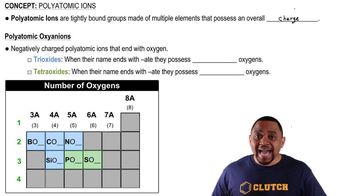
Oxyanions are negatively charged ions that contain oxygen and another element. They often form when an element from the periodic table combines with oxygen, resulting in a polyatomic ion. The naming convention for oxyanions typically involves the number of oxygen atoms present, with suffixes like '-ate' for more oxygen and '-ite' for fewer. Understanding the structure and naming of oxyanions is crucial for predicting the formulas of related ions.
Recommended video:
Guided course
Polyatomic Oxyanions
Periodic Table Groups
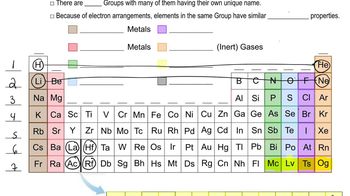
Elements in the same group of the periodic table share similar chemical properties due to their similar valence electron configurations. This similarity extends to the types of ions they form, including oxyanions. For example, elements in Group 16, such as sulfur and selenium, often form oxyanions with similar structures and formulas, which helps in predicting the behavior of these elements in chemical reactions.
Recommended video:
Guided course
Periodic Table: Group Names
Chemical Formula Representation
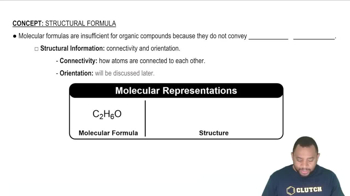
A chemical formula represents the composition of a compound or ion, indicating the types and numbers of atoms present. For oxyanions, the formula includes the central atom and the number of oxygen atoms, along with the overall charge of the ion. In the case of SeO3^2-, the formula indicates that selenium is bonded to three oxygen atoms and carries a -2 charge, which is essential for understanding its reactivity and interactions with other substances.
Recommended video:
Guided course
Molecular Formula
Related Practice
Textbook Question
Textbook Question
Fill in the blanks in the following table:
Cation Anion Formula Name
Lithium oxide
Fe2+ PO43-
Al2(SO4)3
Copper(II) nitrate
Cr3+ I−
MnClO2
Ammonium carbonate
Zinc perchlorate
Complete the third column of the table.
Complete the fourth column of the table.
Textbook Question
Fill in the blanks in the following table:
Cation Anion Formula Name
Lithium oxide
Fe2+ PO43-
Al2(SO4)3
Copper(II) nitrate
Cr3+ I−
MnClO2
Ammonium carbonate
Zinc perchlorate
Complete the first column of the table.
Textbook Question
Many familiar substances have common, unsystematic names. For each of the following, give the correct systematic name: (a) salt peter, KNO3 (b) soda ash, Na2CO3 (c) lime, (d) muriatic acid, HCl, CaO (e) Epsom salts, MgSO4 (f) milk of magnesia, Mg(OH)2.
