
Textbook Question
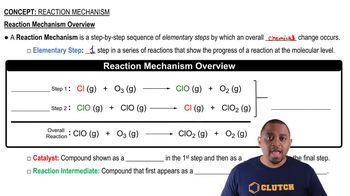
Ozone in the upper atmosphere can be destroyed by the following two-step mechanism:
Cl(g) + O3(g) → ClO(g) + O2(g)
ClO(g) + O(g) → Cl(g) + O2(g)
(b) What is the catalyst in the reaction?

 Verified step by step guidance
 01:32
01:32
 03:06 03:06
Ozone in the upper atmosphere can be destroyed by the following two-step mechanism:
Cl(g) + O3(g) → ClO(g) + O2(g)
ClO(g) + O(g) → Cl(g) + O2(g)
(b) What is the catalyst in the reaction?
Ozone in the upper atmosphere can be destroyed by the following two-step mechanism:
Cl(g) + O3(g) → ClO(g) + O2(g)
ClO(g) + O(g) → Cl(g) + O2(g)
(a) What is the overall equation for this process?
The gas-phase decomposition of ozone is thought to occur by the following two-step mechanism.
Step 1: O3(g) ⇌ O2(g) + O(g) (fast)
Step 2: O(g) + O3(g) → 2 O2 (slow)
(b) Derive the rate law that is consistent with this mechanism. (Hint: The product appears in the rate law.)
The following mechanism has been proposed for the reaction of NO with H2 to form N2O and H2O:
NO(g) + NO(g) → N2O2(g)
N2O2(g) + H2(g) → N2O(g) + H2O(g)
(d) The observed rate law is rate = k[NO]2[H2]. If the proposed mechanism is correct, what can we conclude about the relative speeds of the first and second reactions?
The following mechanism has been proposed for the gasphase reaction of chloroform 1CHCl32 and chlorine:
Step 1: Cl2(g) k1⇌ k-1 2 Cl(g) (fast)
Step 2: Cl(g) + CHCl3(g) k2→ HCl(g) + CCl3(g) (slow)
Step 3: Cl(g0 + CCl3(g) k3→ CCl4 (fast)
(e) What is the rate law predicted by this mechanism? (Hint: The overall reaction order is not an integer.)
The gas-phase decomposition of ozone is thought to occur by the following two-step mechanism.
Step 1: O3(g) ⇌ O2(g) + O(g) (fast)
Step 2: O(g) + O3(g) → 2 O2 (slow)
(d) If instead the reaction occurred in a single step, would the rate law change? If so, what would it be?