
Textbook Question
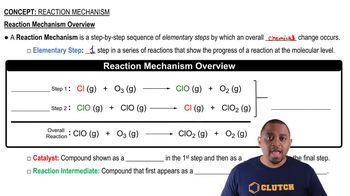
Ozone in the upper atmosphere can be destroyed by the following two-step mechanism:
Cl(g) + O3(g) → ClO(g) + O2(g)
ClO(g) + O(g) → Cl(g) + O2(g)
(b) What is the catalyst in the reaction?

 Verified step by step guidance
 03:06
03:06
 01:52
01:52 01:15
01:15Ozone in the upper atmosphere can be destroyed by the following two-step mechanism:
Cl(g) + O3(g) → ClO(g) + O2(g)
ClO(g) + O(g) → Cl(g) + O2(g)
(b) What is the catalyst in the reaction?
Ozone in the upper atmosphere can be destroyed by the following two-step mechanism:
Cl(g) + O3(g) → ClO(g) + O2(g)
ClO(g) + O(g) → Cl(g) + O2(g)
(a) What is the overall equation for this process?
The following mechanism has been proposed for the reaction of NO with H2 to form N2O and H2O:
NO(g) + NO(g) → N2O2(g)
N2O2(g) + H2(g) → N2O(g) + H2O(g)
(a) Show that the elementary reactions of the proposed mechanism add to provide a balanced equation for the reaction.
The gas-phase decomposition of ozone is thought to occur by the following two-step mechanism.
Step 1: O3(g) ⇌ O2(g) + O(g) (fast)
Step 2: O(g) + O3(g) → 2 O2 (slow)
(a) Write the balanced equation for the overall reaction.
At 28 C, raw milk sours in 4.0 h but takes 48 h to sour in a refrigerator at 5 C. Estimate the activation energy in kJ>mol for the reaction that leads to the souring of milk.