
Textbook Question
Indicate the type of solute–solvent interaction that should be most important in each of the following solutions: c. KBr in water,

 Verified step by step guidance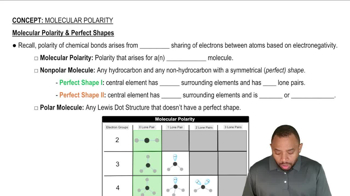
 02:38
02:38
 02:11
02:11 01:25
01:25Indicate the type of solute–solvent interaction that should be most important in each of the following solutions: c. KBr in water,
Indicate the type of solute–solvent interaction that should be most important in each of the following solutions: b. methanol (CH3OH) in water,
Suppose you had a balloon made of some highly flexible semipermeable membrane. The balloon is filled completely with a 0.2 M solution of some solute and is submerged in a 0.1 M solution of the same solute:
Initially, the volume of solution in the balloon is 0.25 L. Assuming the volume outside the semipermeable membrane is large, as the illustration shows, what would you expect for the solution volume inside the balloon once the system has come to equilibrium through osmosis? [Section 13.5]
Indicate the type of solute–solvent interaction that should be most important in each of the following solutions: a. CCl4 in benzene (C6H6),
The diagrams shown represent an emulsion, a true solution, and a liquid crystal. The colored balls represent different liquid molecules. Which diagram corresponds to which type of mixture? [Section 13.6]