(c) What would you predict for the lengths of the bonds in NO2- relative to N¬O single bonds and double bonds?
Ch.8 - Basic Concepts of Chemical Bonding
Brown14th EditionChemistry: The Central ScienceISBN: 9780134414232Not the one you use?Change textbook
Chapter 8, Problem 52a,b,c
For each of the following molecules or ions of sulfur and oxygen, write a single Lewis structure that obeys the octet rule, and calculate the oxidation numbers and formal charges on all the atoms: (a) SO2 Write a single Lewis structure that obeys the octet rule for SO2 and assign the formal charges on all the atoms. (b) SO3 Write a single Lewis structure that obeys the octet rule for SO3 and assign the formal charges on all the atoms. (c) SO32- Write a single Lewis structure that obeys the octet rule for SO32- and assign the formal charges on all the atoms.
Verified step by step guidance1
Draw the skeletal structure of the sulfite ion, SO_3^{2-}, with sulfur (S) as the central atom and three oxygen (O) atoms surrounding it.
Count the total number of valence electrons available. Sulfur has 6 valence electrons, each oxygen has 6, and there are 2 additional electrons due to the 2- charge, giving a total of 26 valence electrons.
Distribute the electrons around the atoms to satisfy the octet rule, starting by placing a single bond (2 electrons) between the sulfur and each oxygen atom.
Place the remaining electrons around the oxygen atoms to complete their octets, and then place any leftover electrons on the sulfur atom.
Calculate the formal charges for each atom using the formula: Formal Charge = (Valence electrons) - (Non-bonding electrons) - 0.5*(Bonding electrons). Assign these charges to each atom in the structure.

Verified video answer for a similar problem:
This video solution was recommended by our tutors as helpful for the problem above.
Video duration:
2mWas this helpful?
Key Concepts
Here are the essential concepts you must grasp in order to answer the question correctly.
Lewis Structures
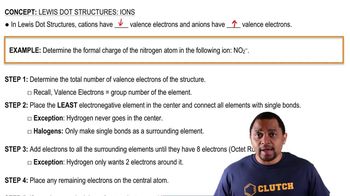
Lewis structures are diagrams that represent the bonding between atoms in a molecule and the lone pairs of electrons that may exist. They are essential for visualizing how atoms share or transfer electrons to achieve stable electron configurations, particularly the octet rule, which states that atoms tend to bond in such a way that they each have eight electrons in their valence shell.
Recommended video:
Guided course
Lewis Dot Structures: Ions
Octet Rule
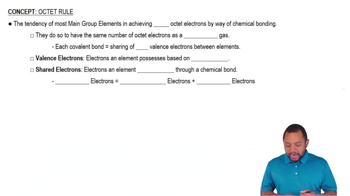
The octet rule is a chemical rule of thumb that reflects the tendency of atoms to prefer having eight electrons in their valence shell, leading to greater stability. This rule is particularly applicable to main group elements and guides the formation of chemical bonds, as atoms will gain, lose, or share electrons to fulfill this requirement.
Recommended video:
Guided course
Octet Rule
Formal Charge
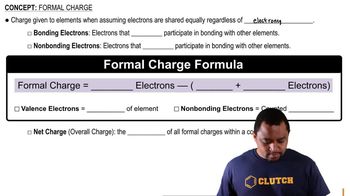
Formal charge is a concept used to determine the charge of an atom in a molecule based on the number of valence electrons it possesses compared to the number of electrons it is assigned in the Lewis structure. It helps in assessing the most stable structure by minimizing the formal charges across the molecule, thus providing insight into the distribution of electrons and the overall charge of the molecule.
Recommended video:
Guided course
Formal Charge
Related Practice
Textbook Question
Textbook Question
Which one of these statements about formal charge is true? (a) Formal charge is the same as oxidation number. (b) To draw the best Lewis structure, you should minimize formal charge. (c) Formal charge takes into account the different electronegativities of the atoms in a molecule. (d) Formal charge is most useful for ionic compounds. (e) Formal charge is used in calculating the dipole moment of a diatomic molecule.
Textbook Question
Write Lewis structures for the following: (a) H2CO (bothH atoms are bonded to C), (b) H2O2, (c) C2F6 (containsa C¬C bond), (d) AsO33 - , (e) H2SO3 (H is bonded to O), (f) NH2Cl.
Textbook Question
(b) With what allotrope of oxygen is it isoelectronic?
Textbook Question
Consider the formate ion, HCO2-, which is the anion formed when formic acid loses an H+ ion. The H and the two O atoms are bonded to the central C atom. (b) Are resonance structures needed to describe the structure?