Consider the formate ion, HCO2-, which is the anion formed when formic acid loses an H+ ion. The H and the two O atoms are bonded to the central C atom. (c) Would you predict that the C—O bond lengths in the formate ion would be longer or shorter relative to those in CO2?
Consider the formate ion, HCO2-, which is the anion formed when formic acid loses an H+ ion. The H and the two O atoms are bonded to the central C atom. (b) Are resonance structures needed to describe the structure?
Verified step by step guidance
Verified video answer for a similar problem:
Key Concepts
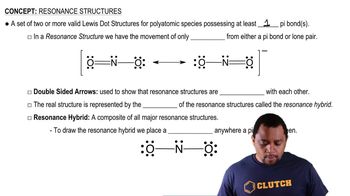
Resonance Structures
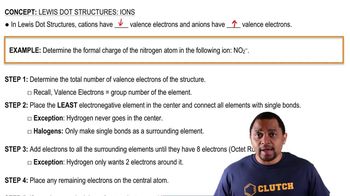
Lewis Structures
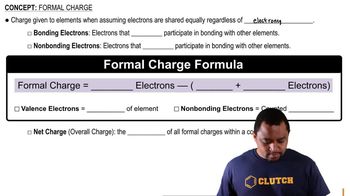
Formal Charge
Predict the ordering, from shortest to longest, of the bond lengths in CO, CO2, and CO32- .
(c) What would you predict for the lengths of the bonds in NO2- relative to N¬O single bonds and double bonds?
For each of the following molecules or ions of sulfur and oxygen, write a single Lewis structure that obeys the octet rule, and calculate the oxidation numbers and formal charges on all the atoms: (a) SO2 Write a single Lewis structure that obeys the octet rule for SO2 and assign the formal charges on all the atoms. (b) SO3 Write a single Lewis structure that obeys the octet rule for SO3 and assign the formal charges on all the atoms. (c) SO32- Write a single Lewis structure that obeys the octet rule for SO32- and assign the formal charges on all the atoms.
Based on Lewis structures, predict the ordering, from shortest to longest, of N¬O bond lengths in NO+, NO2-, and NO3-.
(b) With what allotrope of oxygen is it isoelectronic?
