
Textbook Question
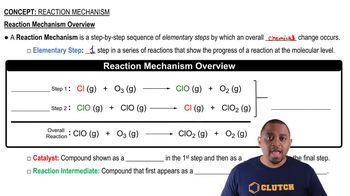
Ozone in the upper atmosphere can be destroyed by the following two-step mechanism:
Cl(g) + O3(g) → ClO(g) + O2(g)
ClO(g) + O(g) → Cl(g) + O2(g)
(b) What is the catalyst in the reaction?
 Verified step by step guidance
 01:32
01:32
 03:06 03:06
Ozone in the upper atmosphere can be destroyed by the following two-step mechanism:
Cl(g) + O3(g) → ClO(g) + O2(g)
ClO(g) + O(g) → Cl(g) + O2(g)
(b) What is the catalyst in the reaction?
Ozone in the upper atmosphere can be destroyed by the following two-step mechanism:
Cl(g) + O3(g) → ClO(g) + O2(g)
ClO(g) + O(g) → Cl(g) + O2(g)
(a) What is the overall equation for this process?
The gas-phase decomposition of ozone is thought to occur by the following two-step mechanism.
Step 1: O3(g) ⇌ O2(g) + O(g) (fast)
Step 2: O(g) + O3(g) → 2 O2 (slow)
(b) Derive the rate law that is consistent with this mechanism. (Hint: The product appears in the rate law.)
The following mechanism has been proposed for the reaction of NO with H2 to form N2O and H2O:
NO(g) + NO(g) → N2O2(g)
N2O2(g) + H2(g) → N2O(g) + H2O(g)
(d) The observed rate law is rate = k[NO]2[H2]. If the proposed mechanism is correct, what can we conclude about the relative speeds of the first and second reactions?
The gas-phase decomposition of ozone is thought to occur by the following two-step mechanism.
Step 1: O3(g) ⇌ O2(g) + O(g) (fast)
Step 2: O(g) + O3(g) → 2 O2 (slow)
(d) If instead the reaction occurred in a single step, would the rate law change? If so, what would it be?