 Back
BackProperties of Water: Structure, Behavior, and Importance in Chemistry
Study Guide - Smart Notes
 Tailored notes based on your materials, expanded with key definitions, examples, and context.
Water: Structure and Molecular Properties
Structure of the Water Molecule
Water (H2O) is a small, polar molecule composed of two hydrogen atoms covalently bonded to one oxygen atom. The molecule has a bent shape due to the two lone pairs on the oxygen atom, resulting in a partial negative charge near the oxygen and partial positive charges near the hydrogens. This polarity enables water to form hydrogen bonds with other water molecules and with other polar substances.
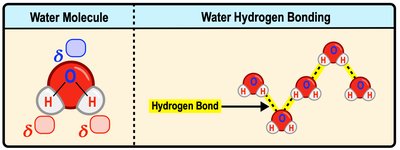
Polarity: The unequal sharing of electrons creates a dipole moment.
Hydrogen Bonding: Weak attractions between the hydrogen atom of one water molecule and the oxygen atom of another.
Emergent Properties of Water
Overview of Key Properties
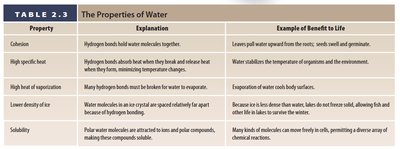
Hydrogen bonding gives rise to several emergent properties of water that are essential for life and chemical processes. These include cohesion, adhesion, high specific heat, lower density of ice, and its role as a universal solvent.
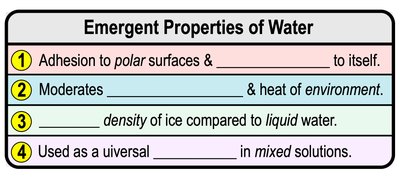
Cohesion: Water molecules stick to each other due to hydrogen bonding.
Adhesion: Water molecules stick to other polar or charged surfaces.
High Specific Heat: Water resists temperature changes due to the energy required to break hydrogen bonds.
Lower Density of Ice: Solid ice is less dense than liquid water, allowing ice to float.
Universal Solvent: Water dissolves many substances due to its polarity.
Cohesion, Adhesion, and Surface Tension
Cohesion and Adhesion
Cohesion refers to the attraction between water molecules, while adhesion is the attraction between water molecules and other substances. These properties are responsible for phenomena such as surface tension and capillary action.
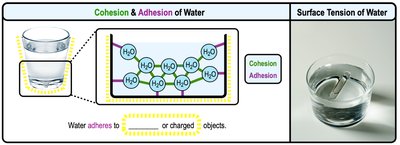
Surface Tension: The measure of how difficult it is to stretch or break the surface of a liquid. Water has a high surface tension due to hydrogen bonding.
Example: Some insects can walk on water due to surface tension.
Density of Water: Liquid vs. Solid
Density and Its Biological Importance
Liquid water is denser than solid ice because, in the solid state, water molecules form a stable lattice structure held together by hydrogen bonds, which spaces the molecules farther apart. This unique property allows ice to float on water, insulating aquatic life in cold climates.
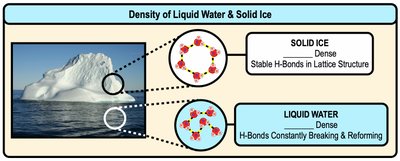
Liquid Water: Molecules are closely packed, hydrogen bonds constantly break and reform.
Solid Ice: Molecules are arranged in a lattice, making ice less dense than liquid water.
Biological Significance: Ice floating on water insulates the liquid below, protecting aquatic life.
Thermal Properties of Water
Kinetic Energy, Temperature, and Heat
Kinetic energy is the energy of motion. Temperature measures the average kinetic energy of molecules, while heat is the total kinetic energy transferred between substances due to a temperature difference.
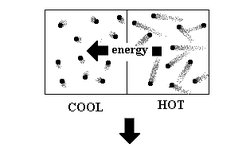
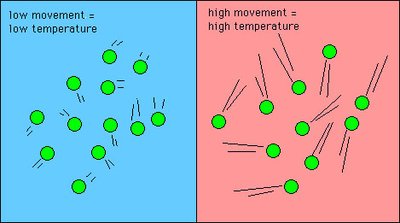
High Specific Heat: Water can absorb or release large amounts of heat with only a slight change in its own temperature.
Formula: (where is heat, is mass, is specific heat, is temperature change)
Example: Large bodies of water moderate climate by absorbing heat in summer and releasing it in winter.
Heat of Vaporization
Heat of vaporization is the amount of energy required to convert 1 gram of a liquid into a gas. Water has a high heat of vaporization due to strong hydrogen bonds, which must be broken for molecules to escape into the vapor phase.
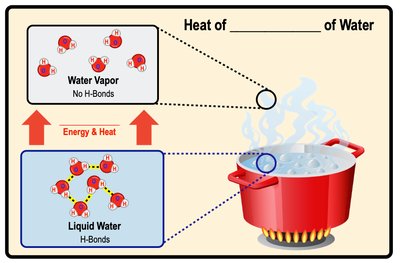
Evaporation: The process by which molecules at the surface of a liquid gain enough energy to become a gas.
Biological Role: Evaporation of sweat cools the body by removing heat.
Water as the Universal Solvent
Solubility and Solution Formation
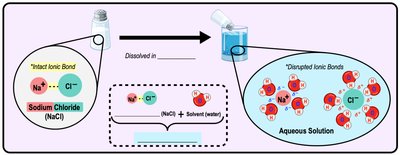
Water is called the "universal solvent" because it dissolves more substances than any other liquid. Its polarity allows it to surround and separate ions and polar molecules, forming aqueous solutions.
Solvent: The substance that dissolves another (water in most biological systems).
Solute: The substance that is dissolved.
Solution: A homogeneous mixture of solute and solvent.
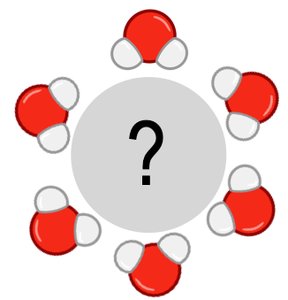
Hydration Shell: Water molecules surround and isolate ions or polar molecules.
Types of Solutions
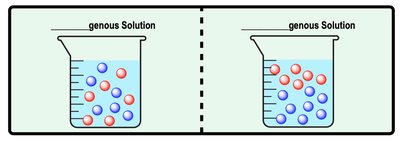
Solutions can be classified as homogeneous (uniform composition) or heterogeneous (non-uniform composition).
Homogeneous Solution: Components are evenly distributed.
Heterogeneous Solution: Components are unevenly distributed.
Hydrophilic vs. Hydrophobic Substances
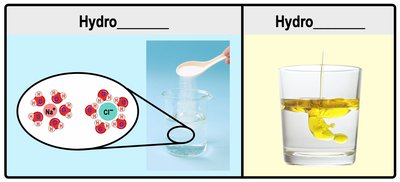
Hydrophilic substances are attracted to water and dissolve easily (e.g., salts, ions, polar molecules). Hydrophobic substances repel water and do not dissolve (e.g., oils, fats, nonpolar molecules).
Hydrophilic: "Water-loving"; polar or charged.
Hydrophobic: "Water-fearing"; nonpolar.
Acids, Bases, and pH
Acids and Bases in Aqueous Solutions
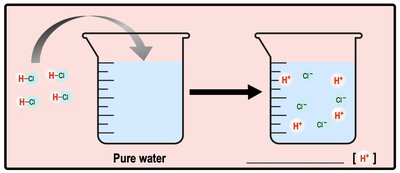
The concentration of hydrogen ions ([H+]) in solution determines acidity. Acids increase [H+], while bases decrease [H+] (often by increasing hydroxide ions, OH-).
![Addition of HCl to water increases [H+]](https://static.studychannel-dev.pearsondev.tech/study_guide_files/general-chemistry/sub_images/13f016d8_image_21.png)
![Addition of NaOH to water decreases [H+]](https://static.studychannel-dev.pearsondev.tech/study_guide_files/general-chemistry/sub_images/13f016d8_image_22.png)
Acid: Donates H+ to solution (e.g., HCl → H+ + Cl-).
Base: Accepts H+ or donates OH- (e.g., NaOH → Na+ + OH-).
The pH Scale
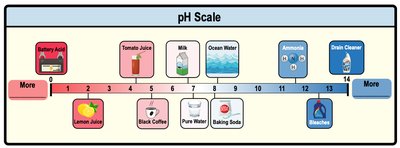
pH is a measure of hydrogen ion concentration, defined as . The scale ranges from 0 (most acidic) to 14 (most basic), with 7 being neutral.
Acidic Solution: pH < 7, [H+] > [OH-]
Neutral Solution: pH = 7, [H+] = [OH-]
Basic Solution: pH > 7, [H+] < [OH-]
Buffers and pH Regulation
Role of Buffers in Biological Systems
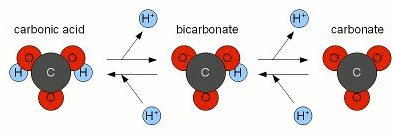
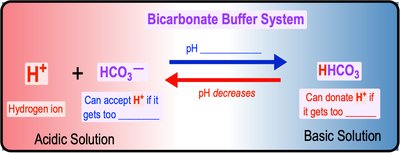
Buffers are substances that minimize changes in pH by accepting or donating H+ ions. They are crucial for maintaining homeostasis in living organisms. The bicarbonate buffer system is a key example in blood, helping to keep pH near neutral.
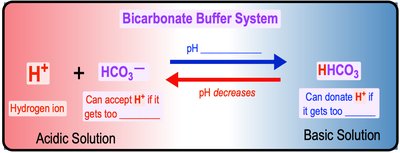
Buffer Action: If [H+] rises, the buffer accepts H+; if [H+] falls, the buffer donates H+.
Example: The bicarbonate buffer system:
Summary Table: Properties of Water
Property | Explanation | Example of Benefit to Life |
|---|---|---|
Cohesion | Hydrogen bonds hold water molecules together. | Leaves pull water upward from the roots; seeds swell and germinate. |
High specific heat | Hydrogen bonds absorb heat when they break and release heat when they form, minimizing temperature changes. | Water stabilizes the temperature of organisms and the environment. |
High heat of vaporization | Many hydrogen bonds must be broken for water to evaporate. | Evaporation of water cools body surfaces. |
Lower density of ice | Water molecules in ice are crystal-like and spaced relatively far apart because of hydrogen bonding. | Because ice is less dense than water, lakes do not freeze solid, allowing fish and other life to survive in winter. |
Solubility | Polar water molecules are attracted to ions and polar compounds, making these compounds soluble. | Many kinds of molecules can move freely in cells, permitting a diverse array of chemical reactions. |
