 Back
BackMatter, Measurement & Problem Solving: Classification of Matter
Study Guide - Smart Notes
 Tailored notes based on your materials, expanded with key definitions, examples, and context.
Classification of Matter
Introduction to Chemistry and Matter
Chemistry is the scientific study of matter and the changes it undergoes. Matter is defined as anything that occupies space and has mass. The basic functional unit of matter is the atom. Understanding the classification of matter is fundamental to the study of chemistry, as it helps in identifying substances and predicting their behaviors.
Chemistry: The study of matter and its transformations, with the atom as its basic unit.
Matter: Anything that occupies space and has mass.
Classification: Matter can be classified into three main types based on its composition and properties.
Types of Matter
Element: The simplest type of matter, composed of only one kind of atom. Elements cannot be broken down into simpler substances by chemical means. Example: Oxygen (O2), Gold (Au).
Compound: Matter composed of two or more different elements that are chemically bonded together. Compounds have properties distinct from their constituent elements. Example: Water (H2O), Sodium chloride (NaCl).
Mixture: Matter composed of elements and/or compounds that are physically mixed together, not chemically bonded. Mixtures can be separated by physical means. Example: Air (a mixture of gases), Salad (a mixture of vegetables).
Classification of Matter: Pure Substances vs. Mixtures
Matter can be further classified based on its composition:
Pure Substances: Have a fixed or uniform composition. They can be either elements or compounds.
Mixtures: Have variable composition and can be separated into their components by physical methods.
Table: Classification of Matter
Type | Composition | Separation | Examples |
|---|---|---|---|
Element | Single type of atom | Cannot be separated into simpler substances | O2, Fe, Au |
Compound | Two or more elements, chemically bonded | Can be separated by chemical means | H2O, NaCl |
Mixture | Two or more substances, physically mixed | Can be separated by physical means | Air, seawater, salad |
Visual Representation: Classification of Matter
The following diagram illustrates the classification of matter into pure substances and mixtures, and further into elements, compounds, homogeneous mixtures, and heterogeneous mixtures.
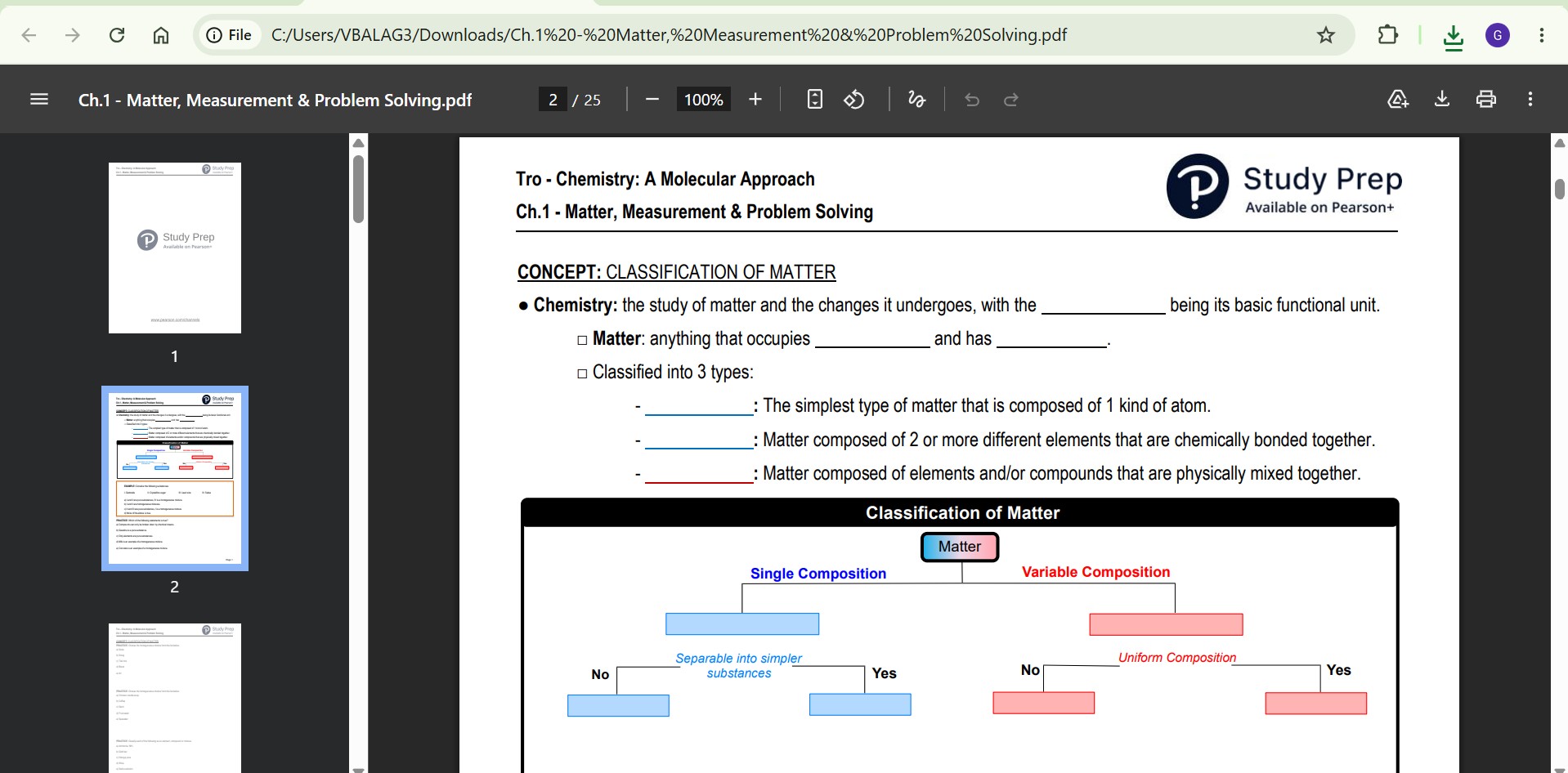
Additional info:
Homogeneous Mixture (Solution): A mixture with uniform composition throughout (e.g., saltwater).
Heterogeneous Mixture: A mixture with non-uniform composition (e.g., sand in water).
Separation Techniques: Physical methods such as filtration, distillation, and chromatography are used to separate mixtures.
