 Back
BackGeneral Chemistry 1 Midterm Study Guidance – Part 1
Study Guide - Smart Notes
 Tailored notes based on your materials, expanded with key definitions, examples, and context.
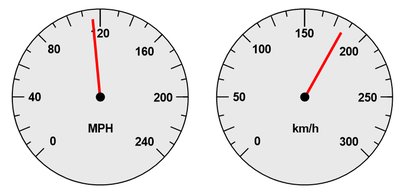
Q11. A vehicle's speedometer is shown below. What is its reading in km/hr and mi/hr? How many significant figures should the reading have?
Background
Topic: Significant Figures and Unit Conversion
This question tests your ability to read measurements from an instrument, convert between units (miles per hour to kilometers per hour), and determine the correct number of significant figures to report based on the instrument's precision.
Key Terms and Formulas
Significant Figures: The digits in a measurement that are known with certainty plus one estimated digit.
Unit Conversion:
Step-by-Step Guidance
Carefully read the value indicated by the red needle on both the MPH and km/h dials. Estimate to the nearest value based on the scale's markings.
Determine how many significant figures are justified by the scale. Consider the smallest increment marked and whether you can estimate between marks.
If you need to convert between mph and km/h, use the conversion factor: .
Apply the rules for significant figures to your final answers in both units, making sure the number of digits reflects the instrument's precision.
Try solving on your own before revealing the answer!
Final Answer:
The speedometer reads 115 mph (3 significant figures) and 185 km/h (3 significant figures).
Both readings are reported to the nearest whole number, matching the precision of the instrument. The correct answer is: a. 115 mph with 3 significant figures and 185 km/h with 3 significant figures
Q26. Visualize elements X and Y as described: Element X (atomic element): Atoms represented by triangles. Element Y (diatomic molecular element): Atoms represented by squares. Draw molecular-level views of each of these elements.
Background
Topic: Atomic and Molecular Elements
This question tests your understanding of the difference between atomic elements (which exist as single atoms) and diatomic molecular elements (which exist as molecules made of two atoms bonded together).
Key Terms and Concepts
Atomic Element: An element that exists in nature as single, unbonded atoms (e.g., noble gases).
Diatomic Molecular Element: An element that naturally exists as molecules composed of two atoms bonded together (e.g., O2, N2, H2).
Step-by-Step Guidance
Recall that atomic elements are represented as individual, unconnected particles (triangles for X).
Diatomic molecular elements are represented as pairs of atoms bonded together (squares for Y, with a line connecting each pair).
Look for the diagram where X is shown as separate triangles and Y is shown as pairs of squares connected by a line.
Try solving on your own before revealing the answer!
Final Answer:
The correct molecular-level view is shown in image_3:
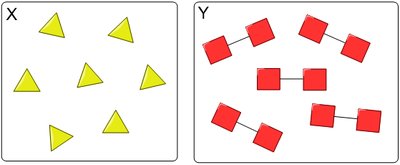
X is represented by individual triangles (atomic element), and Y is represented by pairs of squares connected by a line (diatomic molecular element).
