 Back
BackFundamental Concepts in General Chemistry: Properties, Classification of Matter, and Laws of Combination
Study Guide - Smart Notes
 Tailored notes based on your materials, expanded with key definitions, examples, and context.
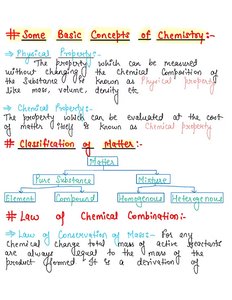
Some Basic Concepts of Chemistry
Physical and Chemical Properties
Chemistry involves the study of matter, its properties, and the changes it undergoes. Understanding the distinction between physical and chemical properties is foundational in general chemistry.
Physical Property: A characteristic of a substance that can be measured or observed without changing its chemical composition. Examples include mass, volume, density, color, and melting point.
Chemical Property: A characteristic that can only be observed during a chemical change, indicating the ability of a substance to undergo a specific chemical transformation. Examples include flammability, reactivity with acids, and oxidation states.
Example: Measuring the boiling point of water is a physical property, while the ability of iron to rust is a chemical property.
Classification of Matter
Types and Subtypes of Matter
Matter can be classified based on its composition and uniformity. This classification helps in understanding the nature and behavior of different substances.
Pure Substances: Have a fixed composition and distinct properties. They are further divided into:
Elements: Substances that cannot be broken down into simpler substances by chemical means (e.g., oxygen, gold).
Compounds: Substances composed of two or more elements chemically combined in fixed proportions (e.g., water, sodium chloride).
Mixtures: Consist of two or more substances physically combined. They are classified as:
Homogeneous Mixtures: Have uniform composition throughout (e.g., saltwater, air).
Heterogeneous Mixtures: Do not have uniform composition (e.g., salad, sand in water).
Example: Air is a homogeneous mixture, while a mixture of oil and water is heterogeneous.
Law of Chemical Combination
Law of Conservation of Mass
The laws of chemical combination govern how substances interact and combine during chemical reactions. The Law of Conservation of Mass is a fundamental principle in chemistry.
Law of Conservation of Mass: States that in a chemical reaction, matter is neither created nor destroyed. The total mass of reactants equals the total mass of products.
Mathematical Expression:
Example: When hydrogen reacts with oxygen to form water, the combined mass of hydrogen and oxygen before the reaction equals the mass of water produced.
