Back
BackAtomic Structure, Bonding, and Chemical Properties: Study Notes
Study Guide - Smart Notes
 Tailored notes based on your materials, expanded with key definitions, examples, and context.
Atomic Structure & Bonding
Ionic vs. Covalent Bonding
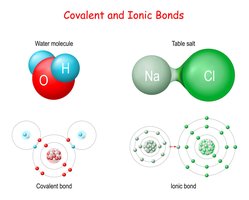
Chemical bonds are the forces that hold atoms together in compounds. The two primary types of chemical bonds are ionic bonds and covalent bonds, which differ in how electrons are distributed between atoms.
Ionic Bonds: Formed when one atom transfers electrons to another, resulting in the formation of oppositely charged ions. Typically occurs between metals and non-metals. The metal loses electrons to become a positively charged cation, while the non-metal gains electrons to become a negatively charged anion. The electrostatic attraction between these ions forms the ionic bond.
Covalent Bonds: Formed when two atoms share one or more pairs of electrons. This usually occurs between non-metal atoms. The shared electrons allow each atom to achieve a stable electron configuration, often resembling that of noble gases.
Example: Sodium chloride (NaCl) is an example of an ionic compound, while water (H2O) is an example of a covalent compound.
Atomic Properties
Atomic Number and Mass Number
Each element is defined by its atomic number and mass number, which describe its nuclear composition.
Atomic Number (Z): The number of protons in the nucleus of an atom. It uniquely identifies the element. For example, sodium (Na) has 11 protons, so its atomic number is 11.
Mass Number (A): The total number of protons and neutrons in the nucleus. For sodium with 11 protons and 12 neutrons, the mass number is .
Periodic Properties
The Stability of Noble Gases
Noble gases (Group 18 elements) are characterized by their lack of chemical reactivity. This is due to their full valence electron shells, which make them energetically stable and unlikely to form chemical bonds under standard conditions.
Full Valence Shell: Most noble gases have eight electrons in their outermost shell (except helium, which has two), satisfying the octet rule.
Chemical Inertness: Their stability means they rarely participate in chemical reactions.
Chemical Reactions
Balancing Chemical Equations
Balancing chemical equations ensures the Law of Conservation of Mass is obeyed: atoms are neither created nor destroyed in a chemical reaction. Each side of the equation must have the same number of each type of atom.
Unbalanced Example:
Balanced Equation:
Explanation: By placing coefficients in front of and , we ensure there are 4 hydrogen atoms and 2 oxygen atoms on both sides of the equation.
Acids, Bases, and the pH Scale
Identifying Acids and Bases
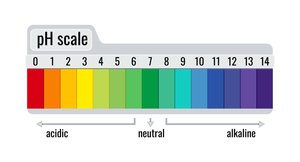
The pH scale measures the concentration of hydrogen ions () in a solution, indicating its acidity or basicity.
Acidic Solutions: pH less than 7 (red/orange on indicators). A pH of 2 indicates a strong acid.
Neutral Solutions: pH equal to 7 (green).
Basic (Alkaline) Solutions: pH greater than 7 (blue/purple).
Example: Lemon juice (pH ≈ 2) is a strong acid; household ammonia (pH ≈ 11) is a base.