 Back
BackAtomic Structure and Nuclear Chemistry: Foundations and Applications
Study Guide - Smart Notes
 Tailored notes based on your materials, expanded with key definitions, examples, and context.
Atomic Structure and Nuclear Chemistry
Historical Development of Atomic Theory
The concept of the atom has evolved over centuries, beginning with philosophical ideas and culminating in modern scientific understanding.
Ancient Greek Philosophers: Proposed that all matter was composed of four elements: air, earth, fire, and water. Democritus introduced the idea of the atom as an indivisible particle (Greek: a = not; tomos = cut).
Law of Conservation of Mass (Lavoisier, 1785): Mass is neither created nor destroyed in chemical reactions.
Law of Constant Composition (Proust, 1794): A chemical compound always contains the same proportion of elements by mass.
Dalton's Atomic Theory (1808):
All matter consists of solid, indivisible atoms.
Atoms are indestructible and retain their identity in chemical reactions.
Atoms of a given element are identical in mass and properties.
Atoms of different elements differ in mass and properties.
Compounds are combinations of elements in small whole-number ratios.
Additional info: Modern atomic theory has modified some of Dalton's postulates, recognizing the existence of subatomic particles and isotopes.
Structure of the Atom
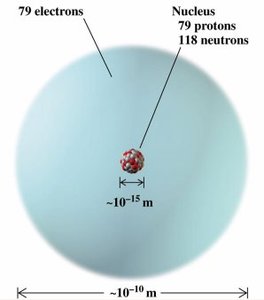
Atoms are composed of three fundamental subatomic particles: protons, neutrons, and electrons.
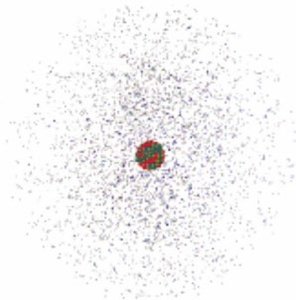
Nucleus: Contains protons and neutrons, accounting for most of the atom's mass and all of its positive charge.
Electrons: Occupy the space around the nucleus, balancing the overall charge of the atom.
Particle | Mass (kg) | Mass (u) | Charge (C) | Charge (relative) | Location |
|---|---|---|---|---|---|
Electron | 9.109382 × 10⁻³¹ | 0.00054858 | -1.602176 × 10⁻¹⁹ | -1 | Outer region |
Proton | 1.672622 × 10⁻²⁷ | 1.007276 | +1.602176 × 10⁻¹⁹ | +1 | Nucleus |
Neutron | 1.674927 × 10⁻²⁷ | 1.008665 | 0 | 0 | Nucleus |
Charge of an atom:
Defining Elements and Isotopes
Each element is defined by its atomic number (number of protons). Atoms of the same element can have different numbers of neutrons, resulting in isotopes.
Atomic Number (Z): Number of protons in the nucleus.
Mass Number (A): Total number of protons and neutrons (nucleons).
Isotopes: Atoms of the same element with different numbers of neutrons (and thus different mass numbers).
Example: Carbon has three naturally occurring isotopes: , , and .
Applications of Isotopes
Isotopes have important applications in science and technology, including dating, tracing, and medical imaging.
Radiocarbon Dating: The ratio of in biological samples can be used to determine the age of objects (e.g., archaeological finds).
Forensic Science: The content in tooth enamel can reveal the year of birth, based on atmospheric levels during nuclear testing.

Measuring Isotopes: Mass Spectrometry
Mass spectrometry is a technique used to determine the relative abundance of isotopes in a sample.
Principle: Ions are separated based on their mass-to-charge ratio in a magnetic field.
Output: A spectrum showing the proportion of each isotope present.


Atomic Mass and Isotopic Abundance
The atomic mass of an element (as listed on the periodic table) is the weighted average of the masses of all naturally occurring isotopes, based on their relative abundances.
Weighted Average Formula:
Example (Silicon): Silicon has three isotopes: 92.23% (27.9769 u), 4.67% (28.9765 u), and 3.10% (29.9738 u). The average atomic mass is calculated using the formula above.
Example (Gallium): Gallium has two isotopes, (68.926 u) and (70.925 u), with an average atomic mass of 69.723 u. The more abundant isotope can be predicted and the natural abundances calculated.
Summary Table: Key Properties of Subatomic Particles
Particle | Symbol | Relative Mass | Charge | Location |
|---|---|---|---|---|
Proton | p+ | 1 | +1 | Nucleus |
Neutron | n | 1 | 0 | Nucleus |
Electron | e- | 1/1836 | -1 | Electron cloud |
Additional Images and Applications
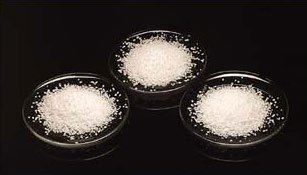
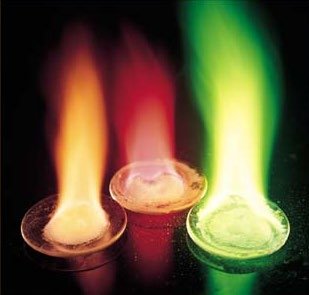
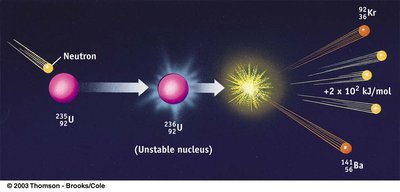
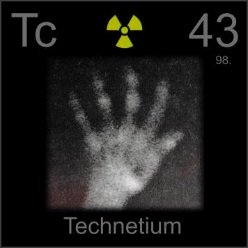
Additional info: The images above illustrate the diversity of atomic and nuclear chemistry applications, from energy production to medical diagnostics.
