 Back
BackAtomic Structure and Isotopes: Foundations of Modern Chemistry
Study Guide - Smart Notes
 Tailored notes based on your materials, expanded with key definitions, examples, and context.
Atomic Structure and Nuclear Chemistry
Historical Development of Atomic Theory
The concept of the atom has evolved over centuries, beginning with philosophical ideas and culminating in scientific theories based on experimental evidence.
Ancient Greek Philosophers: Proposed that all matter was composed of four elements: air, earth, fire, and water. Democritus introduced the idea of the atom as an indivisible particle.
Law of Conservation of Mass (Lavoisier, 1785): Mass is neither created nor destroyed in chemical reactions.
Law of Constant Composition (Proust, 1794): A chemical compound always contains the same proportion of elements by mass.
Dalton's Atomic Theory (1808):
All matter consists of solid, indivisible atoms.
Atoms are indestructible and retain their identity in chemical reactions.
Atoms of a given element are identical in mass and properties.
Atoms of different elements differ in mass and properties.
Compounds are combinations of atoms in small whole-number ratios.
Modern Modifications: Some postulates have been revised (e.g., atoms can be divided in nuclear reactions, isotopes exist).
Structure of the Atom
Atoms are composed of three fundamental subatomic particles: protons, neutrons, and electrons. Most of the atom's mass is concentrated in a tiny nucleus, while electrons occupy the surrounding space.
Proton: Positively charged particle located in the nucleus.
Neutron: Neutral particle also found in the nucleus.
Electron: Negatively charged particle found in the outer regions of the atom.
Particle | Mass (kg) | Mass (u) | Charge (C) | Charge (relative) | Location |
|---|---|---|---|---|---|
Electron | 9.109382 × 10⁻³¹ | 0.00054858 | -1.602176 × 10⁻¹⁹ | -1 | Outer region |
Proton | 1.672622 × 10⁻²⁷ | 1.007276 | +1.602176 × 10⁻¹⁹ | +1 | Nucleus |
Neutron | 1.674927 × 10⁻²⁷ | 1.008665 | 0 | 0 | Nucleus |
Charge of an atom:
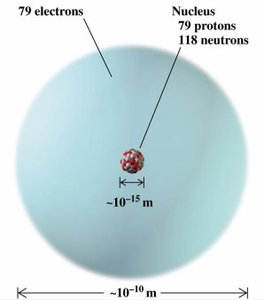
Experimental Evidence: Rutherford's Gold Foil Experiment
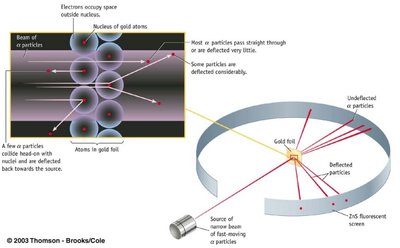
Rutherford's experiment demonstrated that atoms have a small, dense, positively charged nucleus, with most of the atom being empty space.
Most alpha particles passed through gold foil, but some were deflected, indicating a concentrated nucleus.
Defining Elements and Isotopes
Each element is defined by its atomic number (number of protons). Atoms of the same element can have different numbers of neutrons, resulting in isotopes.
Atomic Number (Z): Number of protons in the nucleus.
Mass Number (A): Total number of protons and neutrons (nucleons).
Isotopes: Atoms of the same element with different numbers of neutrons (and thus different mass numbers).
Changing the number of protons changes the element itself.
Examples of hydrogen and carbon isotopes:
(protium), (deuterium), (tritium)
, ,
Applications of Isotopes
Isotope ratios are used in various scientific fields for tracing and dating samples. For example, the amount of in tooth enamel can be used to estimate the year of birth, based on atmospheric levels affected by nuclear testing.
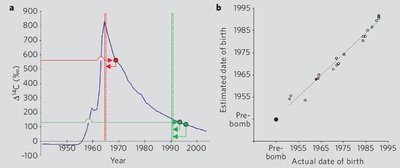
Additional info: This technique is used in forensic science, archaeology, and paleontology for dating biological samples.
Measuring Isotopes: Mass Spectrometry
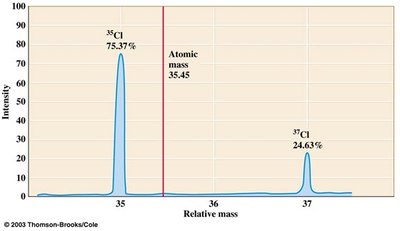
Mass spectrometry is a technique used to determine the isotopic composition of elements by separating ions based on their mass-to-charge ratio.
The main difference between isotopes is their mass.
Mass spectrometers ionize atoms, accelerate them, and separate them using magnetic fields.
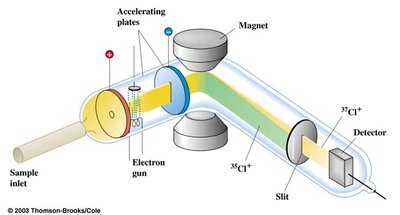
The resulting spectrum shows the relative abundance of each isotope in a sample.
Average Atomic Mass
The atomic mass listed on the periodic table is a weighted average of all naturally occurring isotopes of an element, based on their relative abundance.
Formula for average atomic mass:
Example: Silicon has three isotopes— (92.23%, 27.9769 u), (4.67%, 28.9765 u), (3.10%, 29.9738 u).
To calculate the average atomic mass, multiply each isotope's mass by its fractional abundance and sum the results.
For gallium, given the average atomic mass and the masses of its two isotopes, you can set up equations to solve for their natural abundances.
Summary Table: Key Terms and Concepts
Term | Definition |
|---|---|
Atom | Smallest unit of an element retaining its chemical properties |
Isotope | Atoms of the same element with different numbers of neutrons |
Atomic Number (Z) | Number of protons in the nucleus |
Mass Number (A) | Total number of protons and neutrons |
Mass Spectrometry | Technique for measuring isotopic composition |
Average Atomic Mass | Weighted average mass of all isotopes of an element |
