 Back
BackAldehydes, Ketones, and Carboxylic Acids: Structure and Nomenclature
Study Guide - Smart Notes
 Tailored notes based on your materials, expanded with key definitions, examples, and context.
Aldehydes, Ketones, and Carboxylic Acids
Introduction to Carbonyl Compounds
Organic compounds containing a carbon-oxygen double bond (C=O) are known as carbonyl compounds. The carbonyl group is a fundamental functional group in organic chemistry and is present in several important classes of compounds, including aldehydes, ketones, and carboxylic acids.
Aldehydes: The carbonyl group is bonded to at least one hydrogen atom. General formula: R-CHO
Ketones: The carbonyl group is bonded to two carbon atoms. General formula: R-CO-R'
Carboxylic Acids: The carbonyl group is bonded to a hydroxyl group (-OH). General formula: R-COOH
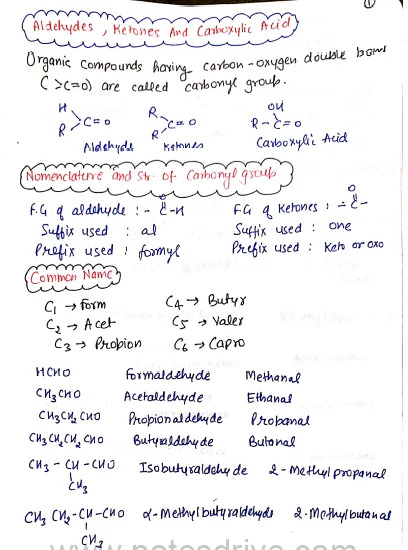
Nomenclature and Structure of Carbonyl Groups
Functional Groups and Naming Conventions
The nomenclature of aldehydes and ketones is based on the position and nature of the carbonyl group. The suffixes and prefixes used in naming these compounds are as follows:
Aldehydes:
Functional group: -CHO
Suffix used: -al (e.g., ethanal)
Prefix used: formyl-
Ketones:
Functional group: >C=O (within the carbon chain)
Suffix used: -one (e.g., propanone)
Prefix used: keto- or oxo-
Example: The compound with the structure CH3CHO is named ethanal (IUPAC) or acetaldehyde (common name).
Common Names of Aldehydes and Ketones
Root Names Based on Carbon Chain Length
Common names for aldehydes and ketones are often derived from the number of carbon atoms in the molecule. The following table summarizes the root names:
Number of Carbons | Root Name |
|---|---|
C1 | Form- |
C2 | Acet- |
C3 | Propion- |
C4 | Butyr- |
C5 | Valer- |
C6 | Capro- |
Examples of Common and IUPAC Names:
Formula | Common Name | IUPAC Name |
|---|---|---|
HCHO | Formaldehyde | Methanal |
CH3CHO | Acetaldehyde | Ethanal |
CH3CH2CHO | Propionaldehyde | Propanal |
CH3CH2CH2CHO | Butyraldehyde | Butanal |
CH3CH(CH3)CH2CHO | Isobutyraldehyde | 2-Methylpropanal |
CH3CH2CH(CH3)CHO | α-Methylbutyraldehyde | 2-Methylbutanal |
Application: Understanding the nomenclature and structure of carbonyl compounds is essential for identifying and predicting the reactivity of organic molecules in chemical reactions.
