Back

Henderson-Hasselbalch Equation quiz

Control buttons has been changed to "navigation" mode.
1/15
  • What does the Henderson-Hasselbalch equation allow you to calculate?

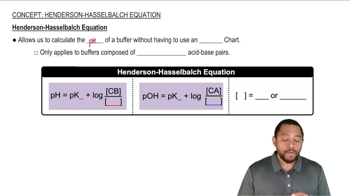
    It allows you to calculate the pH of a buffer solution without using an ICE chart.
  • For which type of solutions does the Henderson-Hasselbalch equation apply?

    It applies to buffer solutions composed of a conjugate acid-base pair.
  • What is the Henderson-Hasselbalch equation when given the acid dissociation constant (Ka)?

    The equation is pH = pKa + log([conjugate base]/[weak acid]).
  • What is the Henderson-Hasselbalch equation when given the base dissociation constant (Kb)?

    The equation is pH = pKb + log([conjugate acid]/[weak base]).
  • What do the brackets in the Henderson-Hasselbalch equation represent?

    The brackets represent either the molarity (concentration) or the moles of the components.
  • When is a buffer considered ideal according to the Henderson-Hasselbalch equation?

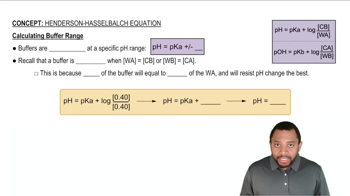
    A buffer is ideal when the concentrations of weak acid and conjugate base (or weak base and conjugate acid) are equal.
  • What does the Henderson-Hasselbalch equation simplify to in an ideal buffer?

    It simplifies to pH = pKa (or pH = pKb) when the concentrations are equal.
  • What is the value of log(1) in the Henderson-Hasselbalch equation, and why is it important?

    Log(1) equals 0, which means the equation simplifies to pH = pKa or pH = pKb in an ideal buffer.
  • What is the effective pH range for a buffer according to the Henderson-Hasselbalch equation?

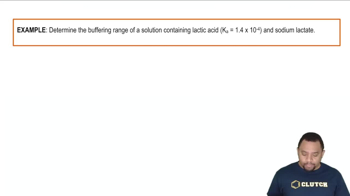
    The effective range is pH = pKa ± 1, where the buffer best resists changes in pH.
  • Why are buffers most effective within the range of pKa ± 1?

    Because within this range, the buffer can best resist sharp changes in pH.
  • What happens to the pH of a buffer when the concentrations of conjugate base and weak acid are equal?

    The pH equals the pKa of the weak acid.
  • Can you use moles instead of molarity in the Henderson-Hasselbalch equation?

    Yes, you can use either moles or molarity in the equation.
  • What is the mathematical relationship between moles, liters, and molarity?

    Moles equal liters times molarity.
  • If you are given Kb instead of Ka, which version of the Henderson-Hasselbalch equation should you use?

    You should use pH = pKb + log([conjugate acid]/[weak base]).
  • Why is it important to know the effective range of a buffer?

    It helps in preparing buffer solutions that maintain a stable pH in various chemical applications.