Skip to main content
General Chemistry
My Course
Learn
Exam Prep
AI Tutor
Study Guides
Textbook Solutions
Flashcards
Explore
Try the app
My Course
Learn
Exam Prep
AI Tutor
Study Guides
Textbook Solutions
Flashcards
Explore
Try the app
Back
Gibbs Free Energy Calculations quiz
You can tap to flip the card.
What is the formula for calculating the standard change in Gibbs free energy (ΔG°)?
You can tap to flip the card.
👆
What is the formula for calculating the standard change in Gibbs free energy (ΔG°)?
ΔG° = ΔH° - TΔS°, where ΔH° is the standard enthalpy change, T is temperature in Kelvin, and ΔS° is the standard entropy change.
Track progress
Control buttons has been changed to "navigation" mode.
1/15
Related flashcards
Related practice
Recommended videos
Gibbs Free Energy Calculations definitions
Gibbs Free Energy Calculations
15 Terms
Gibbs Free Energy Calculations
19. Chemical Thermodynamics
3 problems
Topic
Gibbs Free Energy & Equilibrium
19. Chemical Thermodynamics
7 problems
Topic
Jules
19. Chemical Thermodynamics - Part 1 of 2
5 topics
11 problems
Chapter
Jules
19. Chemical Thermodynamics - Part 2 of 2
4 topics
12 problems
Chapter
Jules
Guided course
00:44
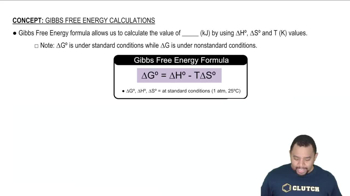
The Gibbs Free Energy Formula
1
views
Guided course
00:32
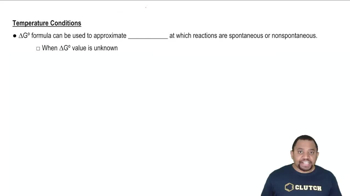
Standard Gibbs Free Energy and Temperature
4
views
Guided course
01:29
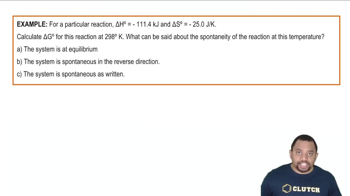
The Gibbs Free Energy Formula Example
1
views
Terms in this set (15)
Hide definitions
What is the formula for calculating the standard change in Gibbs free energy (ΔG°)?
ΔG° = ΔH° - TΔS°, where ΔH° is the standard enthalpy change, T is temperature in Kelvin, and ΔS° is the standard entropy change.
Under what conditions is the standard Gibbs free energy change (ΔG°) calculated?
ΔG° is calculated under standard conditions: 1 atmosphere pressure and 25 °C (298 K).
What does the 'not' symbol (°) in ΔG° indicate?
The 'not' symbol (°) indicates that the value is measured under standard conditions.
How does ΔG differ from ΔG°?
ΔG is the Gibbs free energy change under non-standard conditions, while ΔG° is under standard conditions.
What is the standard Gibbs free energy of formation (ΔG°f) for elements in their natural state?
The standard Gibbs free energy of formation (ΔG°f) for elements in their natural state is zero.
How can you determine the ΔG° of a reaction using ΔG°f values?
ΔG° of a reaction is calculated by summing the ΔG°f values of the products (multiplied by their moles) and subtracting the sum for the reactants.
Why are ΔG°f values typically provided in a chart?
ΔG°f values are unique for each compound and element, making it impractical to memorize them all, so they are provided in a chart.
What units are typically used for Gibbs free energy values?
Gibbs free energy values are typically expressed in kilojoules (kJ) or kilojoules per mole (kJ/mol).
What does a negative ΔG indicate about a reaction's spontaneity?
A negative ΔG indicates that the reaction is spontaneous under the given conditions.
How can the Gibbs free energy formula help predict reaction spontaneity at different temperatures?
By analyzing ΔH and ΔS, the formula can show whether a reaction becomes spontaneous at high or low temperatures.
What is the significance of the summation symbol (Σ) in the ΔG° reaction formula?
The summation symbol (Σ) means you sum the products and reactants' ΔG°f values, each multiplied by their respective moles.
What is the general form of the ΔG° reaction formula using ΔG°f values?
ΔG° = Σ(nΔG°f products) - Σ(nΔG°f reactants), where n is the number of moles.
What temperature scale must be used in the ΔG° formula?
Temperature must be in Kelvin when using the ΔG° formula.
How is the calculation of ΔG° similar to that of ΔS° for a reaction?
Both involve summing the values for products and subtracting the sum for reactants, each multiplied by their moles.
Why is it important to know whether a reaction is spontaneous or not?
Knowing spontaneity helps predict whether a reaction will occur naturally without external energy input.
 BackBack
 00:44
00:44